

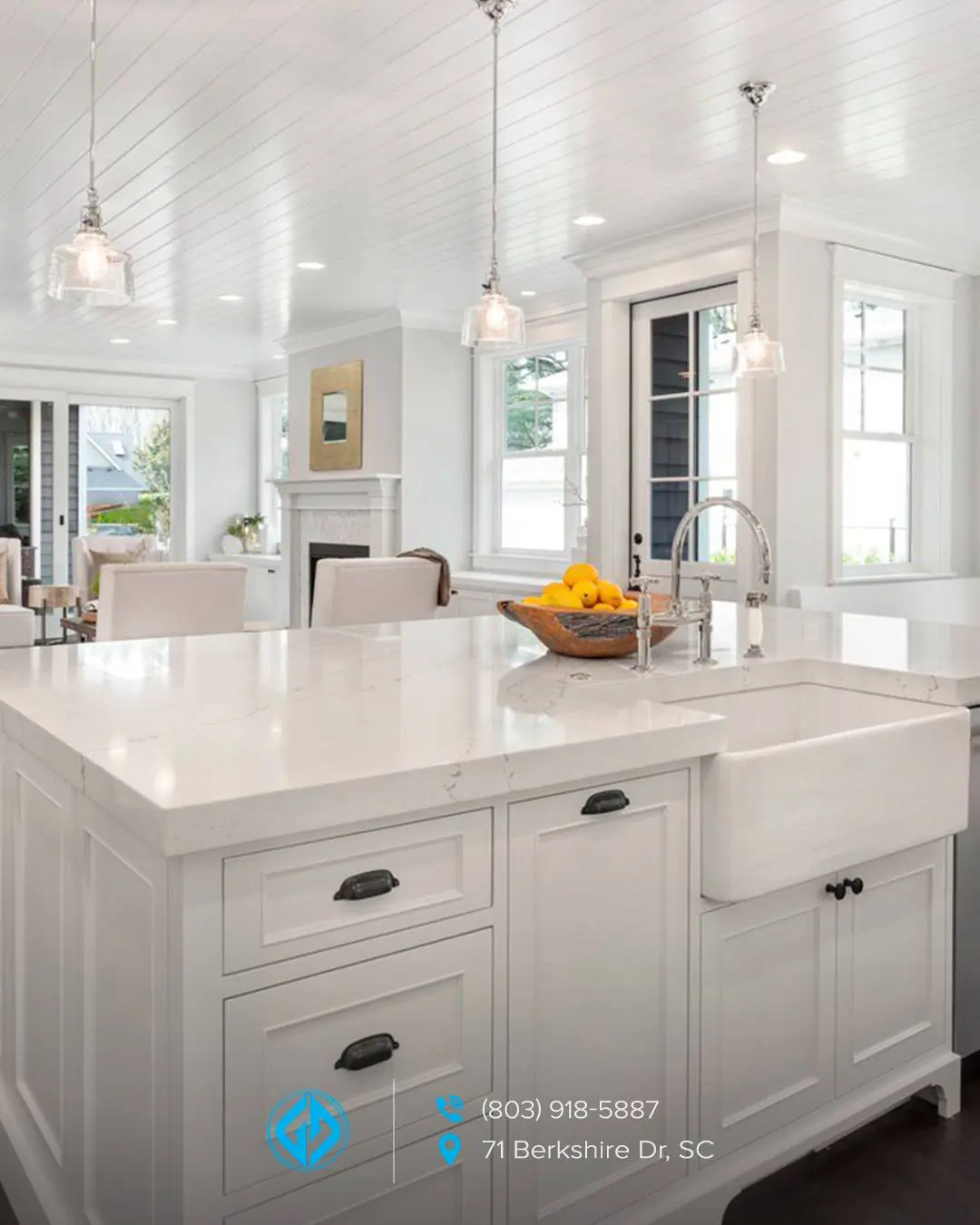
For most residential kitchens, both 2cm and 3cm quartz can be suitable, but 3cm is often preferred for a more substantial countertop appearance and simpler edge fabrication. The right thickness depends on the cabinet layout, countertop design, overhang, edge profile, and the look you want.
Thickness is easy to overlook when choosing quartz because homeowners naturally focus on color and pattern first. However, the thickness affects the countertop’s appearance, edge profile, fabrication, and sometimes the overall project cost.
At Granite Depot of Columbia, we help homeowners looking for quartz countertops in Chester, SC compare these options before fabrication so the selected thickness works with the entire kitchen design.
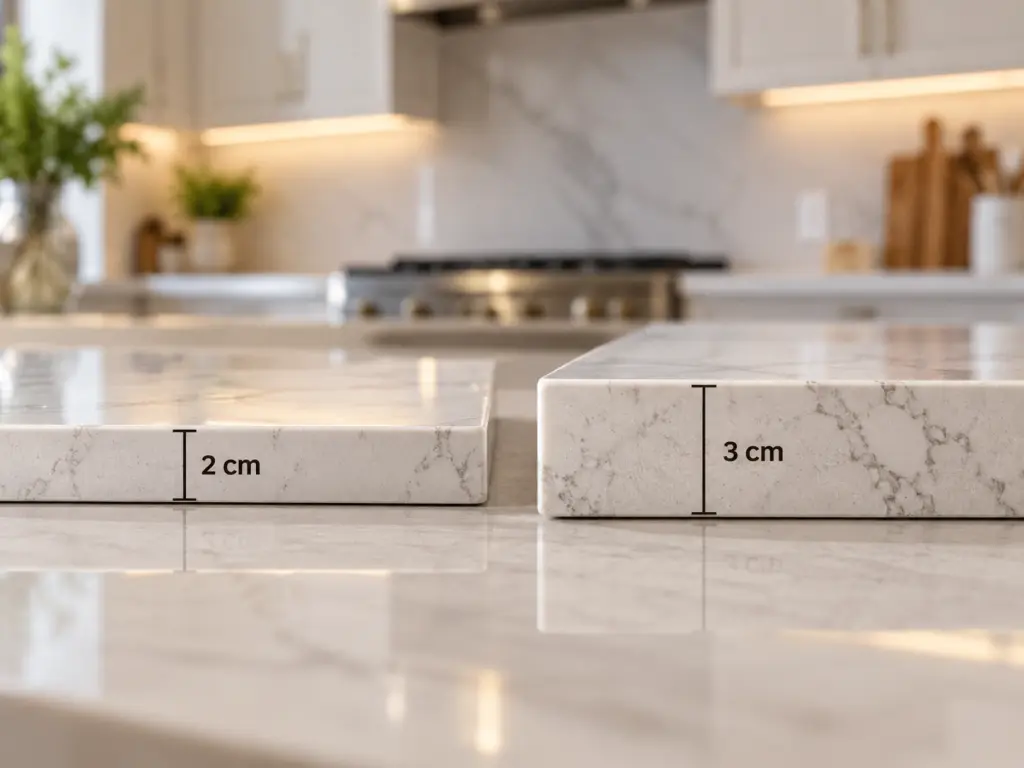
What is the difference between 2cm and 3cm quartz?
The numbers refer to the approximate thickness of the quartz slab.
- 2cm quartz is approximately 20 mm thick.
- 3cm quartz is approximately 30 mm thick.
That extra 10 mm changes the visual weight of the countertop and can affect how the edge is finished.
A 3cm countertop has a naturally substantial edge without requiring the fabricator to build up the edge.
A 2cm slab can also create a thicker-looking edge, but the fabricator may need to laminate an additional strip of quartz around the perimeter.
For homeowners comparing quartz countertops in Chester, SC, this distinction matters because the finished countertop may look different even when the same quartz color is used.
Is 3cm quartz better for a kitchen?
Not automatically. It is simply a different fabrication option with some practical advantages.
3cm quartz is popular because:
- it creates a substantial appearance;
- the edge can often be finished directly from the slab;
- it works well with many standard kitchen designs;
- it is commonly used for islands and large countertop areas.
A 2cm slab can also be an excellent choice when the design calls for a thinner, more contemporary appearance or when the desired edge profile works well with a built-up edge.
The best option depends on the project rather than the idea that thicker always means better.
Is 2cm quartz strong enough for countertops?
Yes, 2cm quartz can be used for residential countertops when it is properly fabricated and supported.
The countertop does not rely on thickness alone for structural performance. Cabinet support, installation, cutouts, overhangs, and fabrication all matter.
This becomes especially important around:
- sink openings;
- cooktop cutouts;
- dishwasher areas;
- large island overhangs;
- unsupported sections.
A professional fabricator evaluates the complete layout rather than choosing thickness in isolation.
What thickness is best for a kitchen island?
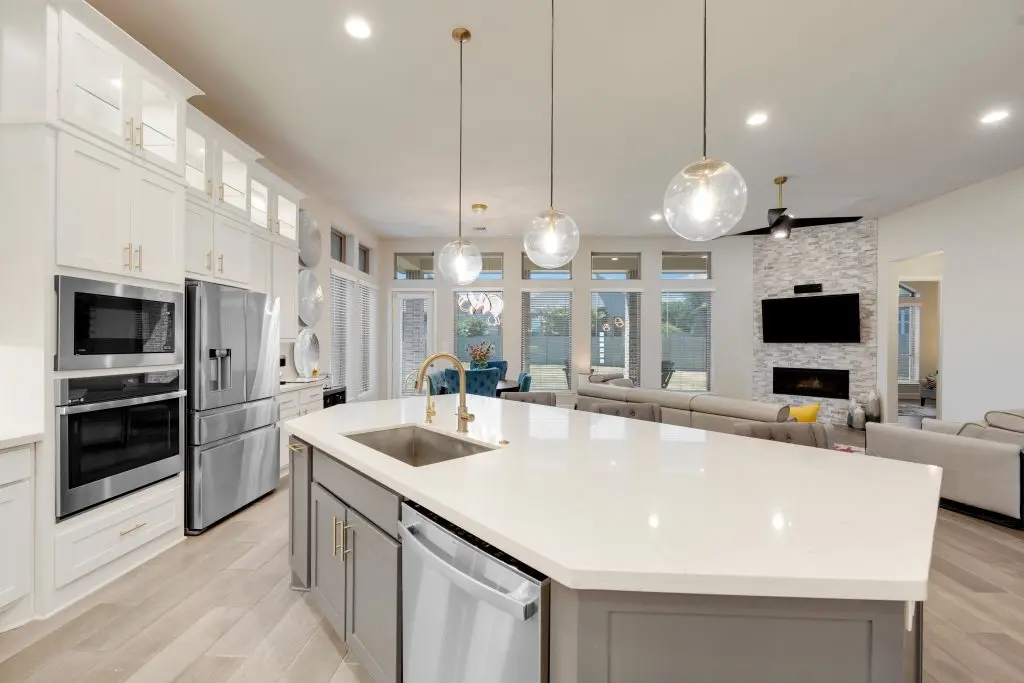
Both thicknesses can work, but 3cm is a popular choice for islands because of its substantial appearance.
Kitchen islands are often the visual centerpiece of the room. A thicker-looking edge can make the island feel more substantial, especially when it includes seating.
For example, a large white quartz island with a 3cm edge can create a clean, architectural appearance without additional decorative details.
A 2cm quartz island can also look excellent, particularly in kitchens where a slimmer profile is part of the design.
The island’s overhang is more important than simply choosing the thickest slab available.
Large seating overhangs may require additional support regardless of whether the quartz is 2cm or 3cm.
Does quartz thickness affect the edge profile?
Yes. This is one of the most noticeable differences.
With 3cm quartz, the slab itself provides a thicker finished edge.
With 2cm quartz, homeowners can choose a thinner edge or use a laminated edge to create the appearance of greater thickness.
Common edge options include:
- eased;
- pencil;
- bevel;
- bullnose;
- ogee;
- mitered edges.
A laminated edge can make 2cm quartz appear similar to a thicker countertop, but it requires additional fabrication.
For homeowners planning quartz countertops in Chester, SC, it is worth discussing the edge profile at the same time as the slab thickness.
Does 3cm quartz cost more than 2cm?
Not necessarily in every project.
The price depends on the quartz product, supplier, fabrication requirements, and current availability. A 2cm slab may require additional edge work, while 3cm material may have a higher material cost.
That means homeowners should compare the complete fabricated and installed price rather than assuming one thickness will always be cheaper.
At Granite Depot of Columbia, quartz starts at approximately $50 per square foot.
For example, the starting material cost would be approximately:
| Countertop area | Starting quartz material cost |
|---|---|
| 30 sq. ft. | $1,500 |
| 40 sq. ft. | $2,000 |
| 50 sq. ft. | $2,500 |
These are material-only examples. The final project price can also include:
- fabrication;
- edge profile;
- sink cutout;
- cooktop cutout;
- backsplash;
- seams;
- delivery;
- installation.
The selected quartz color or collection can also affect the final price.
Does thickness affect the appearance of quartz?
Yes, particularly at the edges.
A 3cm countertop generally has a heavier visual profile.
A 2cm countertop creates a slimmer appearance unless a thicker edge is fabricated.
This can influence the overall kitchen style.
A minimalist kitchen with flat-panel cabinets may work particularly well with a thinner-looking countertop.
A traditional kitchen or large island may benefit from a more substantial edge.
Neither option is universally better. The thickness should complement the cabinets and overall kitchen proportions.
What about quartz bathroom countertops?
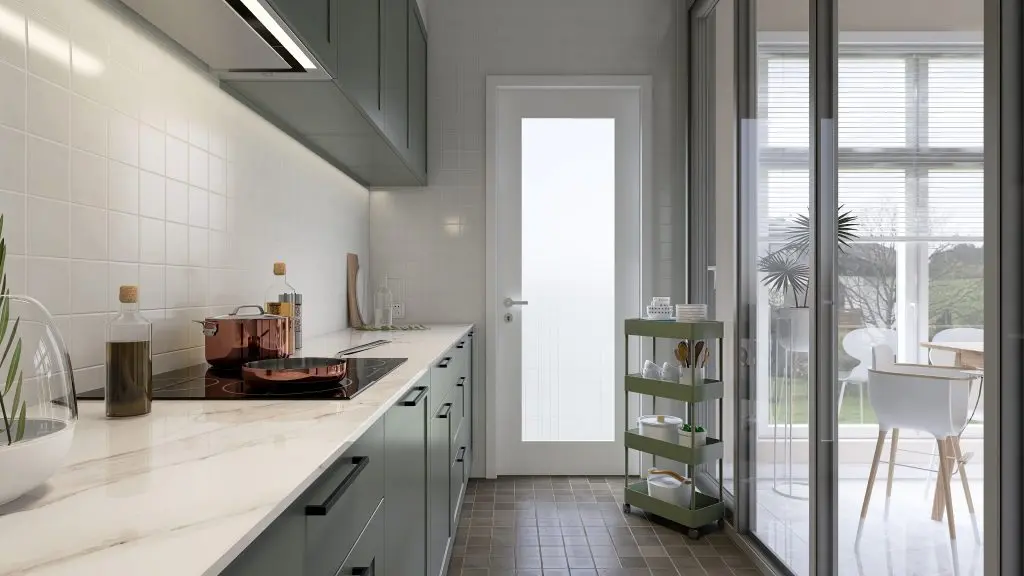
The same 2cm and 3cm options can be used for bathroom vanities, although the design requirements are usually different from a large kitchen island.
Bathroom countertops generally have:
- smaller dimensions;
- sink cutouts;
- faucet holes;
- less seating overhang.
Because of the smaller scale, either thickness can work well.
A 2cm vanity can create a sleek appearance, while 3cm provides a more substantial traditional profile.
The choice often comes down to the desired design rather than structural necessity.
Does a thicker quartz countertop require less maintenance?
No. Thickness does not determine how easy quartz is to maintain.
Both 2cm and 3cm quartz have the same basic maintenance considerations when they are made from the same product.
Quartz is non-porous, so routine care generally involves:
- wiping spills promptly;
- using mild cleaners;
- avoiding abrasive products;
- protecting the surface from prolonged direct heat.
A thicker countertop does not make quartz more resistant to stains or scratches.
Maintenance depends on the quartz material and how the surface is used.
Which quartz thickness should you choose?
For many standard kitchens, 3cm is a straightforward choice when you want a substantial countertop edge without building up the perimeter.
Choose 3cm when you want:
- a thicker visual profile;
- a substantial island appearance;
- a straightforward edge treatment;
- a traditional or transitional look.
Consider 2cm when you want:
- a slimmer profile;
- a contemporary appearance;
- a specific built-up edge;
- flexibility in the finished edge design.
The most important point is to choose the thickness before fabrication so the edge, cutouts, supports, and cabinet layout can all be planned correctly.
How long does quartz countertop installation take?
Most Granite Depot of Columbia countertop projects take approximately 2–3 weeks overall.
After final templating, quartz fabrication generally requires 7–10 business days. During fabrication, the slab is cut to the exact countertop dimensions, sink and appliance openings are created, and the selected edge is finished.
Installation typically takes approximately 1–2 days for a standard kitchen.
Granite Depot of Columbia handles material selection, professional templating, custom fabrication, cutouts, edge finishing, delivery, and installation.
Frequently Asked Questions
Is 2cm or 3cm quartz better?
Neither is universally better. 3cm provides a naturally thicker edge, while 2cm can create a slimmer appearance or be built up for a thicker edge.
Is 2cm quartz strong enough for a kitchen?
Yes, when properly fabricated and adequately supported. Cabinet construction, overhangs, cutouts, and installation all contribute to countertop performance.
How much does quartz cost at Granite Depot of Columbia?
Quartz starts at approximately $50 per square foot. Final pricing depends on the selected quartz, dimensions, thickness, edge profile, cutouts, fabrication, delivery, and installation.
Does thicker quartz last longer?
Not necessarily. A 3cm countertop does not automatically have a longer lifespan than a properly installed 2cm countertop. Installation quality and proper support are important factors.
Does Granite Depot of Columbia serve Chester, SC?
Yes. Granite Depot of Columbia serves homeowners looking for quartz countertops in Chester, SC, providing quartz selection, professional templating, custom fabrication, sink and appliance cutouts, edge finishing, delivery, and installation.
Granite Depot of Columbia
71 Berkshire Dr, Columbia, SC 29223
Phone: (803) 956-4555