

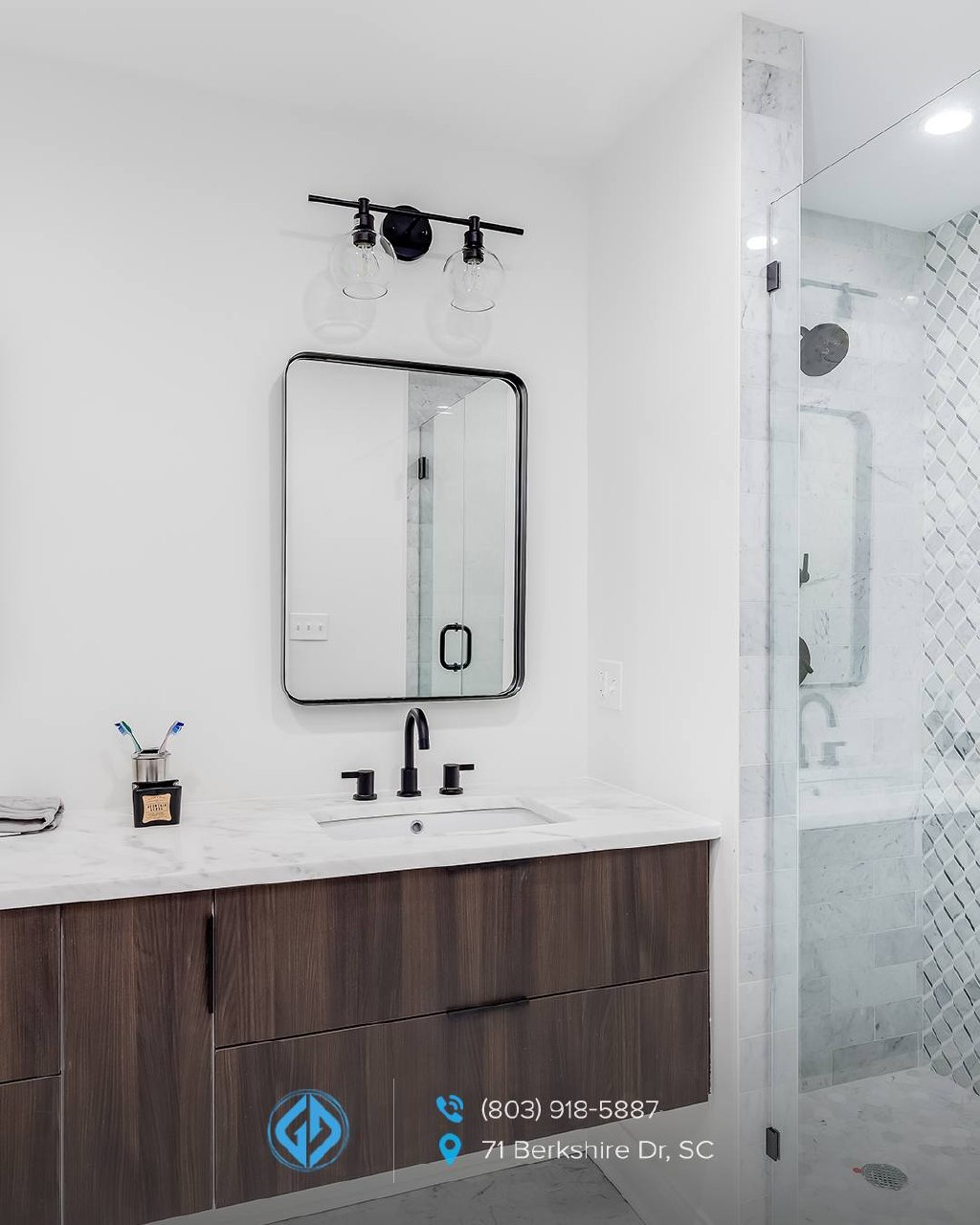
A bathroom vanity countertop can improve the entire room, but the wrong material, color, dimensions, or installation details can make even an expensive remodel feel unfinished. The most common mistakes happen when homeowners choose the countertop separately from the vanity, sink, faucets, lighting, and surrounding finishes.
A successful bathroom design needs more than an attractive slab. The countertop must handle water, cosmetics, soap, cleaning products, and daily use while fitting the room’s proportions. Edge profiles, backsplash height, faucet placement, seams, and overhangs also affect the final appearance.
At Granite Depot of Columbia, we help homeowners compare granite, quartz, marble, and other surfaces according to both style and everyday performance. Avoiding the following seven mistakes can make the difference between a vanity that simply looks new and one that feels intentionally designed.
Why Is Choosing the Countertop Before the Vanity a Mistake?
Choosing the countertop before confirming the vanity is a mistake because the cabinet dimensions and construction determine how the surface must be measured, supported, and fabricated. A countertop cannot be planned accurately around an unknown vanity.
The vanity should be installed, level, and secured before final templating. Even a small difference between advertised and actual cabinet dimensions can affect overhangs, wall gaps, sink placement, and backsplash measurements.
The cabinet color and style also influence the best countertop choice. A dramatic stone may look beautiful on its own but compete with detailed cabinetry. A very plain surface may feel underwhelming when paired with a simple vanity that needs more visual interest.
Homeowners exploring countertops in Kershaw, SC should bring a cabinet door, paint sample, or clear photo when viewing slabs. Seeing the materials together is much more reliable than trying to coordinate colors from memory.

How Can the Wrong Countertop Color Ruin the Bathroom?
The wrong countertop color can make the vanity clash with the flooring, walls, cabinets, and lighting. Bathroom materials are often viewed close together, so mismatched undertones become especially noticeable.
White is not always simply white. Some countertops have cool gray or blue undertones, while others lean cream, beige, or gold. Pairing cool quartz with warm ivory cabinets can make one of the materials look dirty or faded.
Lighting changes the appearance too. A slab viewed under bright showroom lighting may look different in a bathroom with warm bulbs and limited natural light. We recommend checking samples in the room at several times of day.
Homeowners searching for countertops in Kershaw, SC should also know that the safest approach is not necessarily choosing the most neutral surface. It is finding a material whose undertones coordinate with the permanent elements that will remain in the bathroom, particularly tile and flooring.
Why Is Ignoring the Bathroom’s Size a Design Problem?
Ignoring the bathroom’s size is a problem because the scale and movement of the countertop pattern affect how large or crowded the room feels. A design that looks balanced on a large slab may overwhelm a compact vanity.
Strong veining can create an impressive focal point in a spacious primary bathroom. On a 30-inch vanity, however, only a small and potentially awkward section of that pattern may be visible.
Subtle granite, fine-pattern quartz, and softly veined marble often work well in smaller bathrooms. They add detail without visually shrinking the room. Larger spaces can usually handle darker colors, stronger contrast, and broader movement.
Countertop thickness and edge profile also affect proportion. A heavy decorative edge may look oversized on a narrow vanity, while a simple eased edge keeps the design cleaner.
The goal is to select a pattern based on the actual fabricated piece, not only on the appearance of the full slab.
What Happens When You Choose the Wrong Material?
Choosing the wrong material creates unnecessary maintenance or durability problems because granite, quartz, and marble react differently to moisture, cosmetics, heat, and cleaning products.
| Material | Main advantage | Important consideration |
|---|---|---|
| Granite | Durable, heat-resistant natural stone | Periodic sealing may be recommended |
| Quartz | Nonporous and easy to maintain | Strong heat and harsh chemicals should be avoided |
| Marble | Elegant natural veining | Can etch from acidic products |
| Quartzite | Natural beauty and strong durability | Usually requires sealing and may cost more |
Quartz is popular in busy family bathrooms because it does not require routine sealing and resists most everyday stains. Granite provides natural variation and handles heavy use well when maintained correctly.
Marble creates a distinctive, elegant appearance, but it develops a natural patina and may etch when exposed to acidic skincare or cleaning products. That does not make marble a poor choice, but homeowners should understand its character before installation.
At Granite Depot of Columbia, granite starts at approximately $39 per square foot, quartz at $50, and marble at $65. Final pricing depends on the specific material, measurements, sink cutouts, edge profile, backsplash, and installation requirements.
Why Can the Wrong Sink and Faucet Placement Look Awkward?
Incorrect sink and faucet placement can make the vanity feel crowded, unbalanced, or inconvenient to use. These components must fit the countertop depth while leaving comfortable space at the front, back, and sides.
An oversized sink on a small vanity may leave very little visible stone. It can also interfere with drawers or internal cabinet supports. A vessel sink requires a different countertop height and faucet configuration than an undermount sink.
Faucet selection should happen before fabrication whenever possible. Widespread, centerset, single-hole, and wall-mounted faucets all require different planning. Additional holes may also be needed for soap dispensers or accessories.
On a double vanity, symmetry matters. Sink centers, faucet positions, mirror placement, and lighting should align visually. Small measurement differences become obvious when repeated across a long countertop.
Professional templating helps confirm that every cutout works with the vanity construction and the intended bathroom layout.

How Can a Poor Backsplash Choice Ruin the Finished Look?
A poorly planned backsplash can make the countertop look disconnected from the wall or create difficult gaps around mirrors, outlets, and faucets. Its height and material should be decided before fabrication.
A traditional four-inch backsplash is practical, affordable, and easy to coordinate with most bathrooms. A full-height slab backsplash creates a more seamless, luxurious effect and can simplify cleaning around the sink.
Tile is another option, but the transition between the countertop and tile must feel intentional. Busy tile paired with heavily patterned stone may create too much visual movement in a small room.
The wall itself should also be checked. Uneven walls can leave irregular gaps behind a rigid stone backsplash. These conditions should be identified before installation rather than hidden later with excessive caulk.
When helping customers choose countertops in Kershaw, SC, we discuss the backsplash along with the slab because the two surfaces should function as one design rather than separate decisions.
Why Does Cutting Corners on Installation Affect the Entire Vanity?
Cutting corners on installation affects the entire vanity because even a beautiful material can look wrong when seams, overhangs, support, and wall gaps are poorly handled. Accurate fabrication is just as important as slab selection.
The vanity must be level before installation. An uneven cabinet can place stress on the stone, create inconsistent gaps, or prevent the countertop from sitting correctly.
Seams should be planned in the least distracting location. Edge profiles must remain consistent, and sink cutouts should be smooth and properly positioned. Larger overhangs may require additional support, especially on makeup counters or seated vanity areas.
Professional installers also protect the vanity, walls, plumbing, and finished surfaces while moving the countertop into place. Bathroom access can be tight, making careful handling essential.
Our fabrication process generally takes seven to ten business days after templating. Installation usually requires one to two days, depending on the number of vanities and the project’s complexity. Most complete countertop projects are finished within approximately two to three weeks.
Frequently Asked Questions
What countertop material is easiest to maintain in a bathroom?
Quartz is generally the easiest to maintain because it is nonporous and does not need sealing. Mild soap, water, and a soft cloth are usually enough for routine cleaning.
Is granite a good choice for a bathroom vanity?
Yes. Granite is durable, moisture-resistant when properly maintained, and available in many colors. Periodic sealing may be recommended depending on the specific stone.
How much do bathroom countertops cost in Kershaw, SC in 2026?
At Granite Depot of Columbia, material prices start at approximately $39 per square foot for granite, $50 for quartz, $65 for marble, and $75 for quartzite. Final pricing depends on the selected color, slab category, vanity dimensions, sink cutouts, edge profile, backsplash, and installation details. A smaller bathroom vanity does not always require a full slab, so remnants may sometimes provide a more budget-friendly option.
Should a vanity countertop have a backsplash?
A backsplash is strongly recommended because it protects the wall from water and cleaning products. It may be a short matching stone piece, tile, or a full-height slab.
Does Granite Depot of Columbia serve Kershaw, SC?
Yes. We work with homeowners looking for countertops in Kershaw, SC. Although our showroom is located in Columbia, our team provides material selection, templating, fabrication, delivery, and professional installation for projects throughout the Kershaw area.
Granite Depot of Columbia
71 Berkshire Dr
Columbia, SC 29223
Phone: (803) 956-4555