

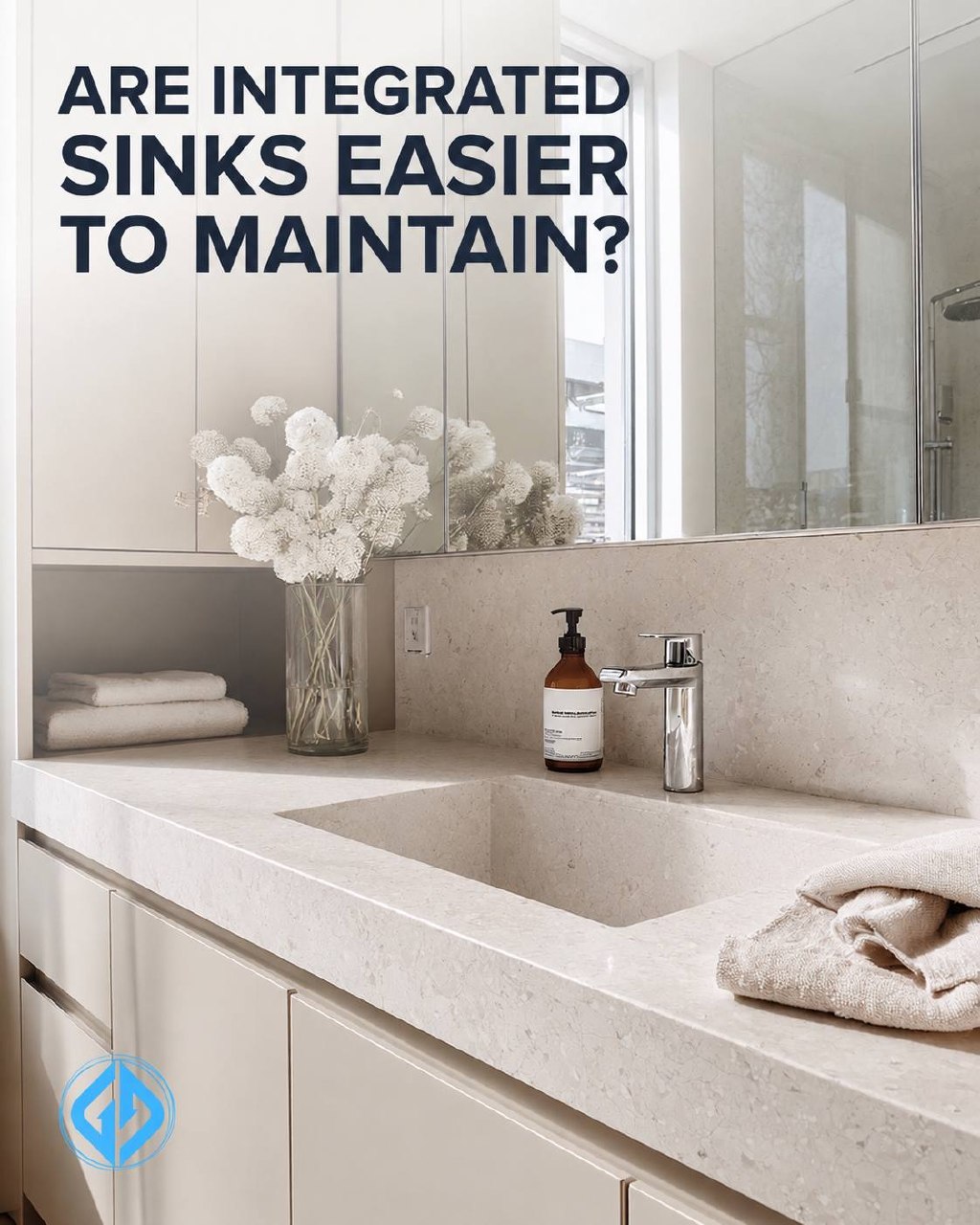
Yes — integrated sinks are the easiest sink configuration to maintain of the three main options. Because the sink is fabricated from the same material as the countertop with no seam or joint between the two surfaces, there’s no edge for grime, water, or debris to collect at the sink-to-counter transition. Cleaning becomes a single continuous wipe from countertop to sink basin with nothing to catch in between.
The trade-off is material limitation and cost — integrated sinks are only practical in quartz and solid surface materials, not in granite, marble, or quartzite, and they typically cost more than a standard undermount configuration. Understanding both sides of that trade-off is what determines whether an integrated sink is the right choice for a specific kitchen or bathroom.
At Granite Depot of Columbia, we work with countertop fabricators in Manning, SC projects and throughout the Midlands region, and integrated sink questions come up regularly — particularly for bathroom vanities and laundry room sinks. Here’s the complete picture.
What exactly is an integrated sink — and how is it different from undermount?
An integrated sink is fabricated as a single continuous piece with the countertop — the same material flows from the counter surface directly into the basin with no seam, no separate piece, and no transition point. The sink and countertop are one object.
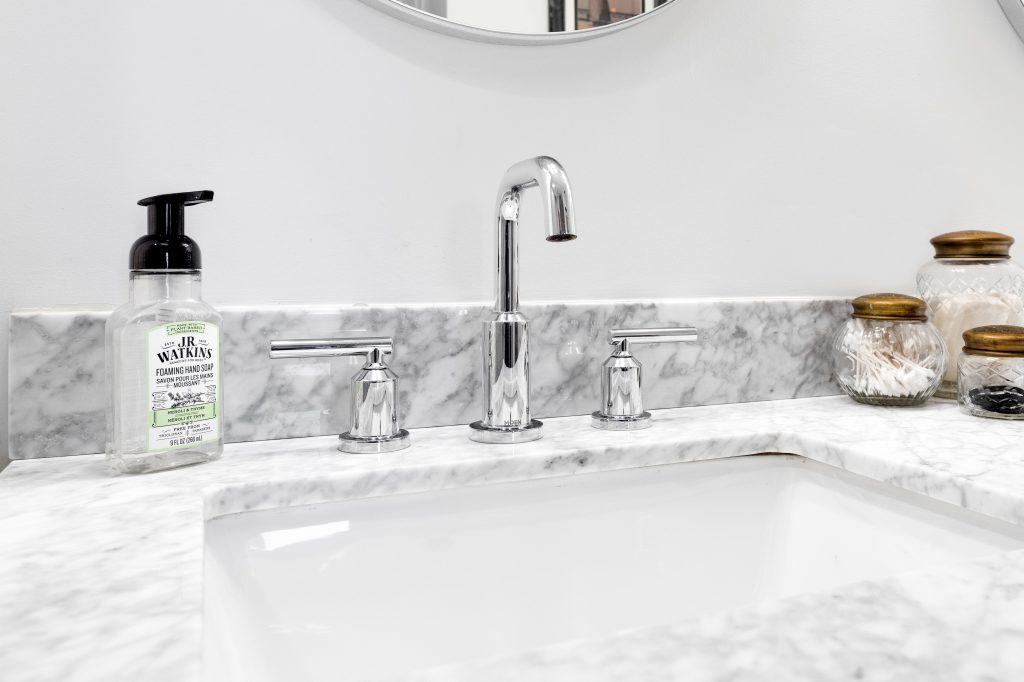
An undermount sink, by contrast, is a separate sink basin mounted underneath the countertop from below. The countertop material has a cutout, and the sink is attached and sealed at the perimeter of that cutout. Even with the cleanest undermount installation, there is a seam — a sealed joint where the countertop edge meets the sink rim, typically a thin line of silicone or adhesive.
That seam is where the maintenance difference originates. An undermount seam, however well-sealed, is a place where water sits, where grime can accumulate over time, and where the seal itself can degrade and require resealing or recaulking after several years. An integrated sink has no equivalent — there’s nothing to seal because there’s no joint.
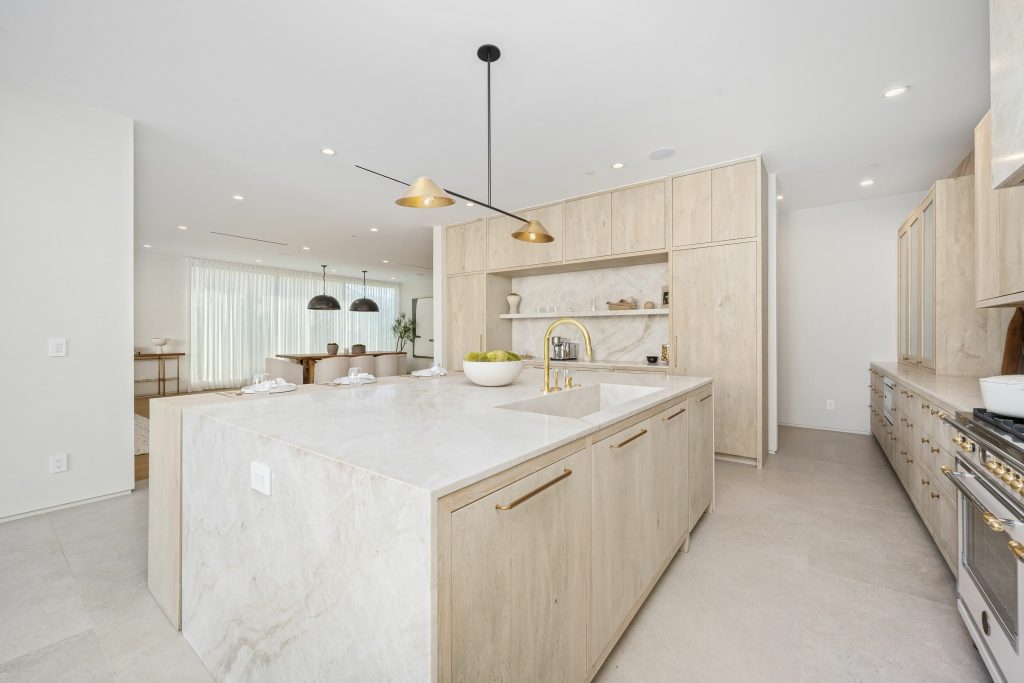
Why are integrated sinks limited to quartz and solid surface materials?
The fabrication process that creates an integrated sink requires a material that can be molded or thermoformed into a continuous shape — which is fundamentally different from how natural stone is fabricated.
Quartz and solid surface materials — including brands like Corian, LG Hi-Macs, and certain Cambria and Caesarstone product lines — are manufactured products that can be formed into integrated sink shapes during production or fabricated from sheet material with seamless thermal bonding at the basin. The resin-based composition of these materials allows for this kind of forming in ways that natural stone doesn’t.
Granite, marble, and quartzite are cut from natural slabs. There’s no manufacturing process that creates a continuous granite countertop-and-sink as a single piece — the material simply doesn’t exist that way. Natural stone sinks do exist as a category — hand-carved stone vessel sinks and basins — but these are separate pieces installed as undermount or vessel configurations, not integrated with the countertop slab.
This is the fundamental reason integrated sinks are a quartz and solid-surface category specifically. For countertop fabricators in Manning, SC customers who want the maintenance benefits of an integrated sink but prefer the look and performance of natural stone, the practical compromise is usually a well-executed undermount installation on granite or quartzite — which delivers most of the clean aesthetic with a properly sealed seam that, while present, performs well with normal maintenance.
Where do integrated sinks make the most practical sense?
Integrated sinks have specific applications where their maintenance advantages are most valuable — and other applications where the limitations make them less practical.
Bathroom vanities are the strongest application for integrated sinks. The combination of frequent water contact, toothpaste, soap residue, and skincare products makes the seamless transition particularly valuable — there’s no seam for product buildup to accumulate, and the entire surface wipes clean in one motion. Quartz integrated bathroom vanity tops are increasingly popular in Middle Tennessee for exactly this reason. Quartz starts at $50 per square foot at Granite Depot of Columbia in 2026.
Laundry room sinks benefit similarly — detergent residue, lint, and the general mess of laundry tasks are easier to manage on a continuous surface than around a seamed undermount sink edge.
Kitchen applications are less common for integrated sinks, primarily because most homeowners want a kitchen sink basin made from stainless steel, fireclay, or composite granite — materials with specific performance characteristics for cooking-related tasks that quartz integrated basins don’t fully replicate. An integrated quartz kitchen sink is possible but represents a smaller share of kitchen installations compared to bathroom and laundry applications.
| Application | Integrated Sink Fit | Why |
|---|---|---|
| Bathroom vanity | Excellent | Frequent water contact, easiest cleanup |
| Laundry room | Very good | No seam for detergent/lint buildup |
| Kitchen | Less common | Stainless/fireclay preferred for cooking tasks |
How much more does an integrated sink cost compared to undermount?
Integrated sinks typically cost more than a standard undermount configuration — though the gap is usually smaller in bathroom applications than in kitchens, where the size and configuration differences are more significant.
For a bathroom vanity, an integrated quartz sink top typically adds $200 to $500 over a standard quartz countertop with a separate undermount sink, depending on the specific product line and basin configuration. Part of this cost reflects the more specialized fabrication process — integrated sink tops are often manufactured as pre-formed units from specific product lines rather than fabricated from standard slab material.
The cost difference is offset over time by what it eliminates — no separate sink purchase, no sink-to-counter sealing during installation, and no resealing of that seam every few years. For a bathroom vanity that will see daily use for fifteen to twenty years, the lifetime maintenance reduction is a meaningful factor even if the upfront cost is higher.
For countertop fabricators in Manning, SC customers planning a bathroom renovation, comparing the integrated sink cost against the full lifetime cost of an undermount configuration — including periodic resealing — often narrows the gap considerably.
Are there any maintenance downsides to integrated sinks?
The main consideration isn’t a downside in the traditional sense, but a difference worth understanding — integrated sinks, like the quartz or solid surface material they’re made from, share the maintenance profile of that material specifically.
Quartz integrated sinks don’t require sealing — ever — which is consistent with quartz’s broader maintenance advantages. They do share quartz’s heat sensitivity — placing very hot items directly in or near the basin repeatedly over years carries the same resin-related risk as quartz countertops generally.
Solid surface integrated sinks (like Corian) are slightly softer than quartz and can show scratches more visibly over time, though minor surface scratches on solid surface materials can sometimes be buffed out — a repair option that isn’t available for quartz or natural stone.
Neither material requires the kind of seam maintenance that undermount configurations eventually need — and that absence of seam maintenance is the core maintenance advantage that makes integrated sinks worth considering for the right application.
Frequently Asked Questions
Are integrated sinks easier to clean than undermount sinks?
Yes — integrated sinks have no seam between the countertop and the sink basin, which means there’s no joint for grime, water, or product residue to accumulate. Cleaning is a single continuous wipe from countertop to basin. Undermount sinks have a sealed seam at the perimeter that requires periodic attention and eventual resealing over the lifetime of the installation.
Can you get an integrated sink with granite or marble countertops?
No — integrated sinks are only available in quartz and solid surface materials because of how those materials are manufactured and fabricated. Granite, marble, and quartzite are cut from natural slabs and cannot be formed into a continuous countertop-and-sink piece. For natural stone, a well-executed undermount installation is the closest equivalent in terms of clean aesthetic.
How much do quartz countertops with integrated sinks cost in Manning, SC in 2026?
At Granite Depot of Columbia, quartz starts at $50 per square foot in 2026. An integrated quartz sink for a bathroom vanity typically adds $200 to $500 over a standard quartz countertop with a separate undermount sink, depending on the product line and basin configuration. For a standard single-sink vanity, total cost with an integrated sink typically runs $800 to $1,800 fully installed.
How long does installation take for a countertop with an integrated sink?
Most projects at Granite Depot of Columbia are completed within two to three weeks from first contact to installed countertops. Integrated sink tops for bathroom vanities often use pre-formed product lines, which can sometimes streamline fabrication slightly compared to custom cutouts — though the overall timeline remains consistent with standard projects.
Does Granite Depot of Columbia serve Manning, SC?
Yes. We operate from one location — 71 Berkshire Dr, Columbia, SC 29223 — and serve homeowners looking for countertop fabricators in Manning, SC and throughout Clarendon County regularly. We have no separate office in Manning, but our team completes projects there consistently. Call us at (803) 956-4555 to schedule a visit or get a quote.