

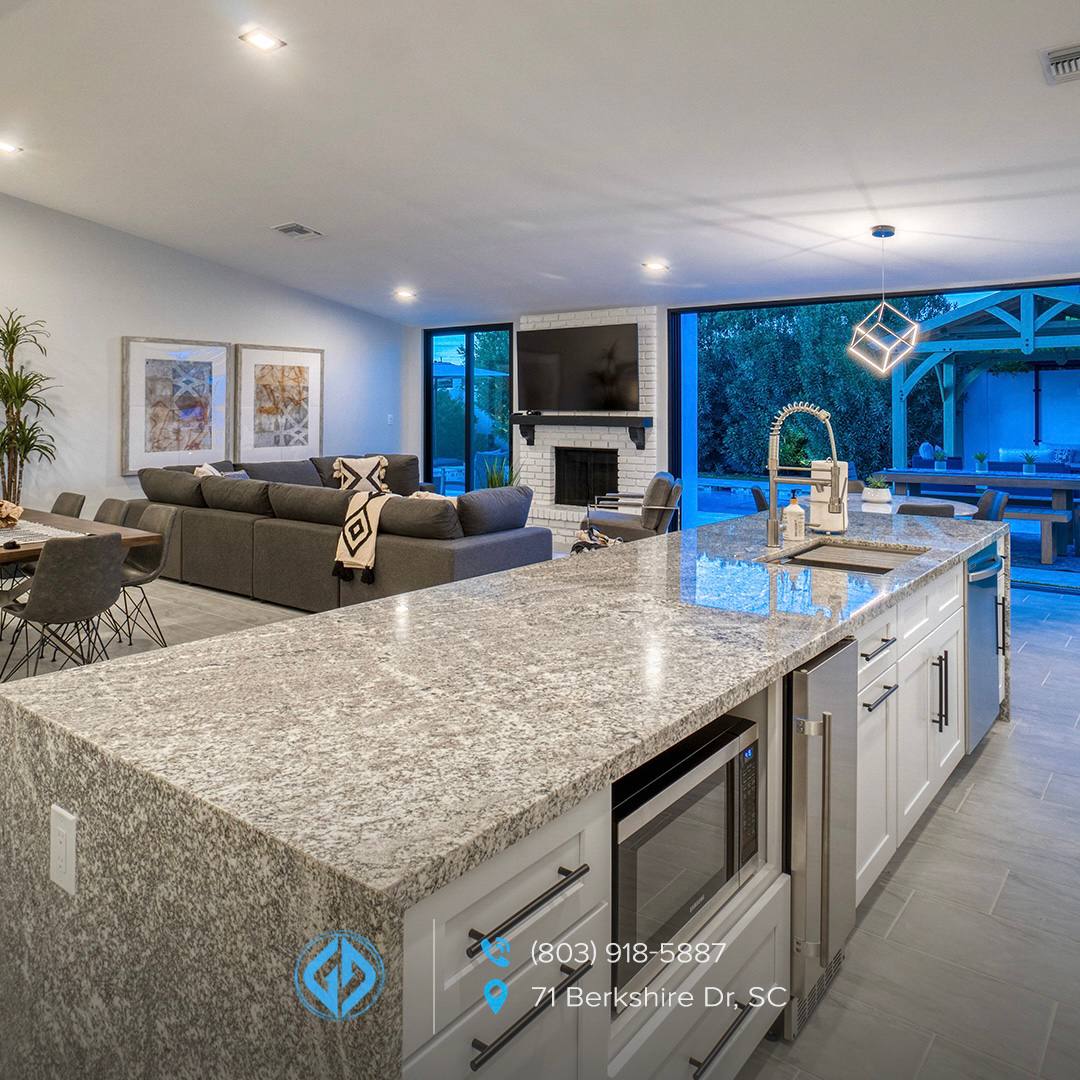
A waterfall edge can add several hundred dollars to the price of a kitchen island, and in some projects it can add considerably more. The final increase depends on whether the stone continues down one or both sides, the island dimensions, the selected material, slab size, pattern-matching requirements, edge fabrication, and whether the design forces the project to use an additional slab.
The most important detail is that a waterfall is not simply a decorative edge upgrade. It adds full vertical countertop panels to the island. A two-sided waterfall commonly requires approximately 18–24 additional square feet of material, depending on the island depth and height.
At Granite Depot of Columbia, granite starts at approximately $39 per square foot. For homeowners considering custom granite countertops in Kershaw, SC, the actual waterfall cost must be calculated from the island measurements and selected slab rather than added as one universal fee.
Why does a waterfall island cost more than a standard island?
A waterfall island costs more because it requires additional stone, more complicated fabrication, careful pattern alignment, and extra installation labor.
A standard island usually has one horizontal countertop with a finished edge around the perimeter. A waterfall design extends that material vertically from the countertop to the floor on one or both ends.
Those vertical sections must be measured, cut, transported, and installed like separate countertop pieces. The fabricator also creates mitered or precisely finished joints where the horizontal top meets each side panel.
When a slab has strong movement, the pieces must be laid out so the veins appear to continue naturally around the corner. That process requires more planning and may create additional slab waste.
How much extra granite does a waterfall edge require?
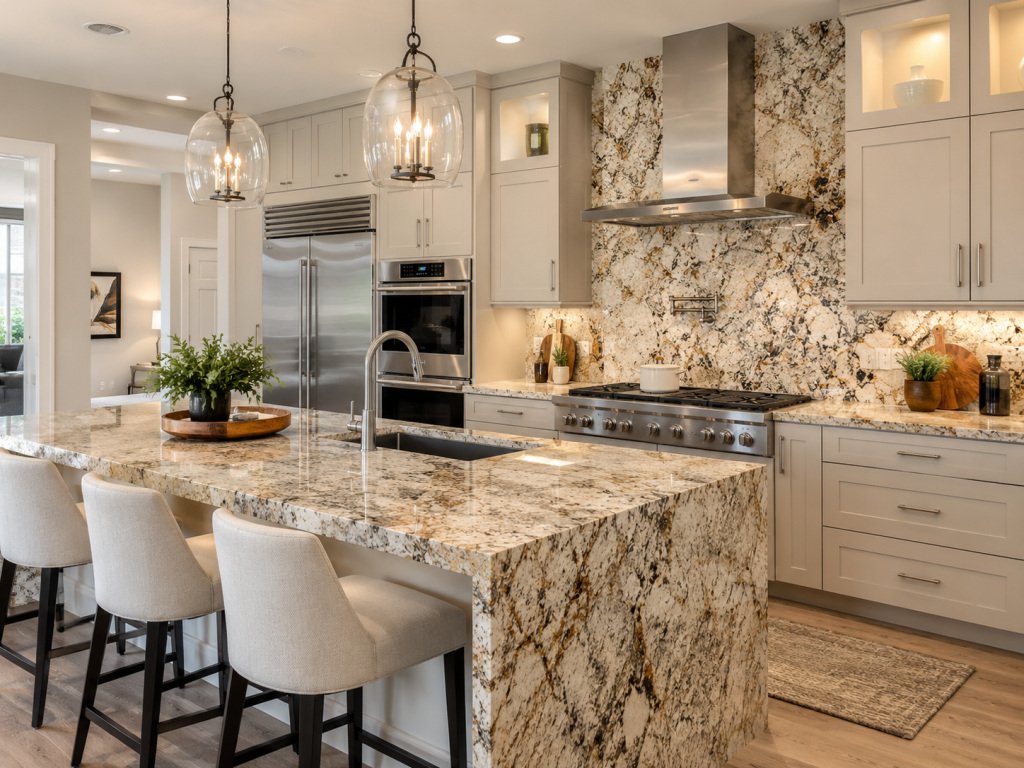
A typical two-sided waterfall can require roughly 18–24 additional square feet of granite.
For example, an island that is approximately 36 inches high and 36 inches deep needs about nine square feet for each waterfall panel. A deeper 48-inch island may need around 12 square feet per side.
At Granite Depot of Columbia’s granite starting price of $39 per square foot, the added granite alone could begin around:
| Waterfall configuration | Approximate added stone | Granite material value from $39/sq. ft. |
|---|---|---|
| One 36-inch side | About 9 sq. ft. | From approximately $351 |
| One 48-inch side | About 12 sq. ft. | From approximately $468 |
| Two 36-inch sides | About 18 sq. ft. | From approximately $702 |
| Two 48-inch sides | About 24 sq. ft. | From approximately $936 |
These figures illustrate only the approximate value of the added granite at the starting material price. They are not complete installed waterfall quotes.
Fabrication, pattern matching, mitered joints, transportation, support, slab yield, and installation can raise the final project cost.
Does a waterfall edge always require another slab?
No, but needing another slab is often the biggest reason a waterfall island becomes significantly more expensive.
A standard kitchen layout may fit within one or two slabs. Adding two full-height island panels can push the required square footage beyond what remains available.
Stone is not priced like fabric that can always be purchased in a small custom amount. If the waterfall pieces do not fit into the existing slab layout, the customer may need to purchase another slab or move into a different project category.
This is especially relevant with natural stone. Granite slabs vary in size, and strong patterns affect which areas can be used together.
A fabricator may technically have enough square footage left, but those remnants may not produce attractive vein continuity or matching color across the island.
For custom granite countertops in Kershaw, SC, an efficient slab layout can therefore make a major difference in the final cost.
Does the countertop material change the waterfall price?
Yes. The starting cost of the material directly affects the value of every additional square foot used on the island sides.
At Granite Depot of Columbia, our known starting prices are:
| Material | Starting price | Waterfall consideration |
|---|---|---|
| Granite | From $39/sq. ft. | Natural variation requires slab planning |
| Quartz | From $50/sq. ft. | More consistent pattern options |
| Marble | From $65/sq. ft. | Premium look with greater maintenance |
| Quartzite | Price available upon request | Premium natural stone; exact slab matters |
Granite often offers strong value for a waterfall island because it combines natural beauty, excellent heat resistance, and a lower starting price than quartz or marble.
Quartz can simplify pattern coordination when the design has relatively consistent movement. Brands such as Cambria, Silestone, Caesarstone, MSI Quartz, and Vicostone offer both subtle patterns and dramatic Calacatta-inspired designs.
Marble and quartzite can create highly luxurious waterfall islands, but natural variation, premium pricing, and fabrication complexity must be considered before selecting the slab.
Which granite patterns work best for a waterfall island?
Granite with directional movement creates the most dramatic waterfall effect, while more consistent patterns are usually easier and more economical to fabricate.
Granites such as Luna Pearl, New Caledonia, Dallas White, and Santa Cecilia have relatively distributed patterns. Slight changes in piece orientation may be less noticeable, which can make the waterfall layout more flexible.
Granite such as River White, White Ice, or an exotic selection with long mineral movement requires more deliberate slab planning.
With directional stone, the fabricator may create a book-matched or vein-matched appearance around the edge. This can look exceptional, but it may also require using less of the slab efficiently so the visual transition remains convincing.
Homeowners should inspect the full slab rather than approving the design from a small sample. A sample shows the color family; it does not show how the movement will travel across the island top and down the sides.
Is a one-sided waterfall more affordable?
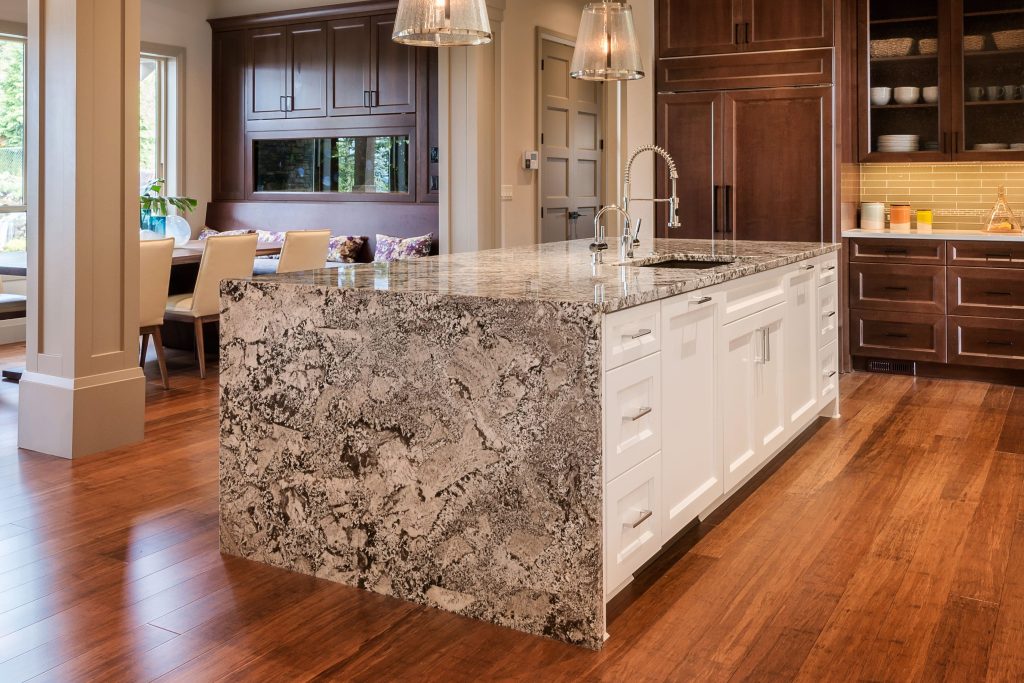
Yes. A one-sided waterfall uses less material and requires one fewer vertical panel and corner joint.
This option works particularly well when one side of the island is highly visible while the other side meets cabinetry, a wall, seating, or another architectural feature.
A one-sided design can still create the modern waterfall look without paying for a second panel that is rarely seen.
However, symmetry matters. On a freestanding island viewed from multiple directions, one waterfall side may appear intentional or unfinished depending on the room layout.
At Granite Depot of Columbia, we consider traffic flow, seating placement, island orientation, slab dimensions, and viewing angles before recommending one or two waterfall panels.
What other details can increase the final price?
The most common additional cost factors are complex seams, thick-looking edges, support requirements, appliance cutouts, and difficult installation conditions.
A waterfall may look like one uninterrupted piece, but it is fabricated from separate sections. Creating tight joints requires accurate templating and careful cutting.
Other factors include:
- a built-up or mitered edge that makes the countertop appear thicker;
- heavily veined stone requiring precise matching;
- outlets installed in the waterfall panel;
- uneven flooring that complicates the final fit;
- oversized islands requiring more installers;
- limited access through doors or stairways;
- sink or cooktop cutouts affecting slab placement;
- polished, honed, or leathered finishes;
- additional cabinet or floor support.
A detailed project quote should clearly distinguish material, fabrication, and installation instead of listing only an attractive square-foot price.
Is a waterfall edge worth the investment?
A waterfall edge is worth considering when the island is a major visual feature and the additional stone fits comfortably within the renovation budget.
It does not improve countertop performance. Its value is primarily architectural and visual.
A waterfall can conceal the side of the island cabinets, protect the end panel from daily contact, and make a freestanding island appear more substantial. It is particularly effective in open-concept kitchens where the island is visible from the living or dining area.
It may not be the best use of the budget when the island is small, partially hidden, or surrounded by other strong design elements. In those situations, investing in a higher-quality slab, better sink, full-height backsplash, or additional storage may provide more noticeable everyday value.
For homeowners choosing custom granite countertops in Kershaw, SC, we recommend comparing the cost of one-sided and two-sided waterfall layouts before making the final decision.
Frequently Asked Questions
How much does a two-sided granite waterfall add in material cost?
A typical two-sided waterfall may use approximately 18–24 additional square feet. With granite starting at $39 per square foot at Granite Depot of Columbia, the added granite value may begin around $702–$936, before extra fabrication, mitering, installation, support, and possible slab requirements.
Is quartz more expensive than granite for a waterfall island?
Quartz generally starts higher at Granite Depot of Columbia. Granite begins around $39 per square foot, while quartz starts around $50 per square foot. The final difference depends on the specific color, brand, slab requirements, and complexity of the waterfall fabrication.
Can any granite be used for a waterfall edge?
Most granite can be used, but the appearance varies significantly. Consistent patterns are easier to coordinate, while directional or heavily veined slabs require more careful layout and may create additional waste. The full slab should be reviewed before fabrication.
How long does a waterfall countertop project take?
Most countertop projects take approximately 2–3 weeks overall. Fabrication generally requires 7–10 business days after templating, while installation typically takes 1–2 days, depending on the island size and complexity.
Does Granite Depot of Columbia serve Kershaw, SC?
Yes. Granite Depot of Columbia serves homeowners seeking custom granite countertops in Kershaw, SC, including slab selection, professional templating, custom fabrication, waterfall-edge planning, delivery, and installation.
Granite Depot of Columbia
71 Berkshire Dr, Columbia, SC 29223
Phone: (803) 956-4555