

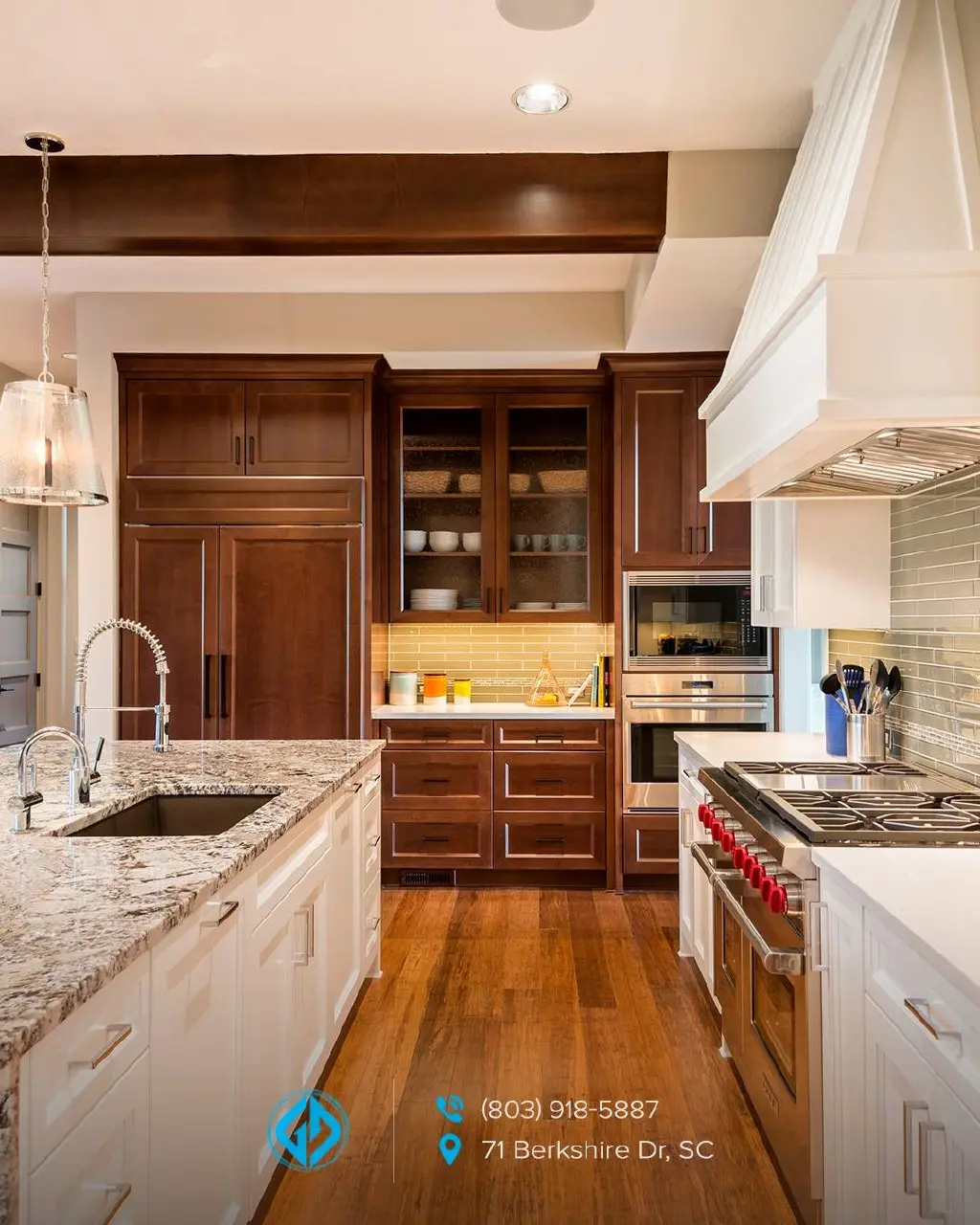
Your granite island does not have to match the perimeter countertops. Using the same granite creates a cohesive, traditional look, while choosing a different granite for the island can make it a stronger focal point. Both approaches work – the better choice depends on your cabinets, backsplash, flooring, lighting, and how much contrast you want.
At Granite Depot of Columbia, we help homeowners decide how different granite slabs will work together before fabrication. For customers comparing granite stores in Chester, SC, this is especially useful because looking at two granite colors next to each other is very different from judging them separately.
Should the island and perimeter countertops match?
No. Matching is a design preference, not a requirement.
Using one granite throughout the kitchen creates continuity. The eye moves naturally around the room without encountering a major change in color or pattern.
A contrasting island creates a different effect. It separates the island visually from the perimeter and can make the island feel more like a piece of furniture.
For homeowners researching granite stores in Chester, SC, the decision usually comes down to three options:
- the same granite everywhere;
- two different granite colors;
- granite on one surface and another material, such as quartz, on the other.
If you already have busy cabinets or backsplash tile, matching granite may provide better balance. If the rest of the kitchen is relatively simple, a contrasting island can add personality.
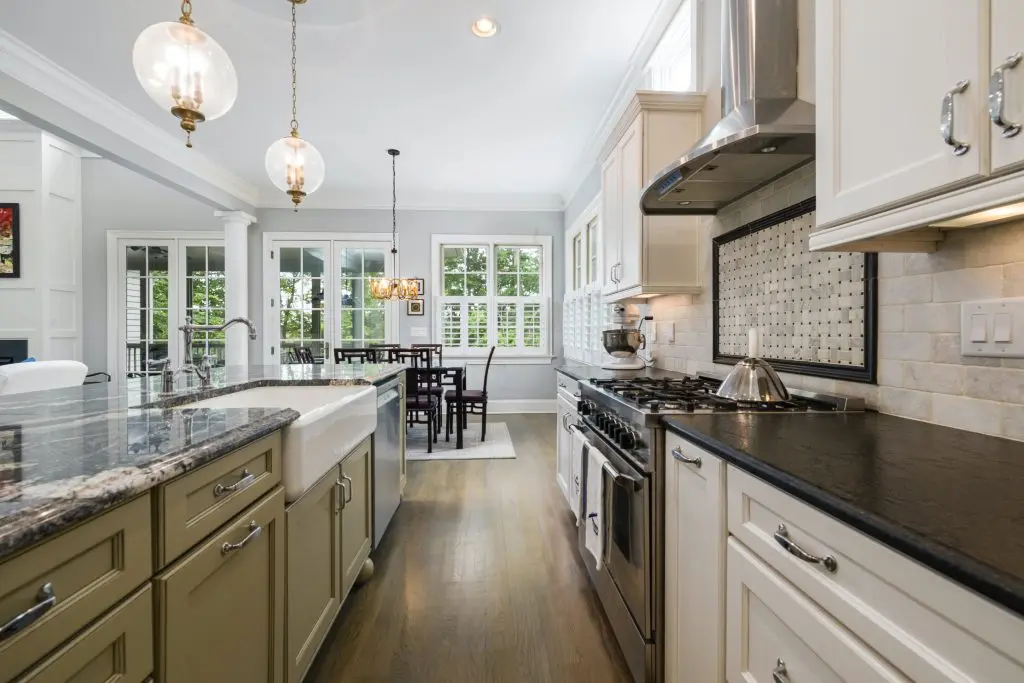
When does matching granite look better?
Matching granite is often the safest choice when you want a calm, unified kitchen.
It works particularly well with:
- traditional kitchens;
- smaller kitchens;
- detailed cabinetry;
- patterned backsplashes;
- open-concept spaces where the kitchen connects directly to another room.
Using one stone also allows the natural pattern to flow across the entire kitchen.
For example, a granite with subtle cream and gray movement can create a consistent background for white cabinets, while the same stone on the island keeps the overall design restrained.
Matching is also useful when you do not want the island to become the main focal point.
When should you use different granite on the island?
A different granite works well when the island is large enough to serve as a visual centerpiece.
A few combinations can create strong contrast:
Light perimeter + dark island
White or cream granite around the perimeter paired with black or charcoal granite on the island creates a dramatic effect.
Quiet perimeter + dramatic island
A relatively subtle granite around the cabinets allows a heavily veined or highly patterned island slab to stand out.
Warm perimeter + complementary island
Beige or cream granite can be paired with another stone containing similar warm undertones but a different overall pattern.
When comparing granite stores in Chester, SC, ask to see the slabs together. The colors do not need to match exactly, but they should have some visual relationship.
How do you make two granite colors work together?
The easiest method is to identify one shared color or undertone.
The two slabs might both contain:
- cream;
- white;
- gray;
- brown;
- black;
- gold.
For example, a white-and-gray granite perimeter can work with a darker granite island that also contains subtle gray or white movement.
The backsplash can then connect the two.
Think of the kitchen as a three-part color relationship:
perimeter countertops + island + backsplash
If all three have completely unrelated colors and patterns, the kitchen can feel disjointed.
If they share even one or two visual elements, the combination usually feels more intentional.
Should the granite patterns match?
Not necessarily.
In fact, trying to find two granite slabs with identical patterns can make the design unnecessarily complicated.
Natural granite is unique, and even slabs from the same material can vary in movement and mineral distribution.
Instead of matching the patterns, coordinate their characteristics.
For example:
- quiet granite + dramatic granite;
- small-scale movement + large-scale movement;
- light background + dark background with shared undertones.
The island can carry the stronger pattern while the perimeter remains visually quieter.
This approach gives the kitchen a focal point without making every surface compete for attention.
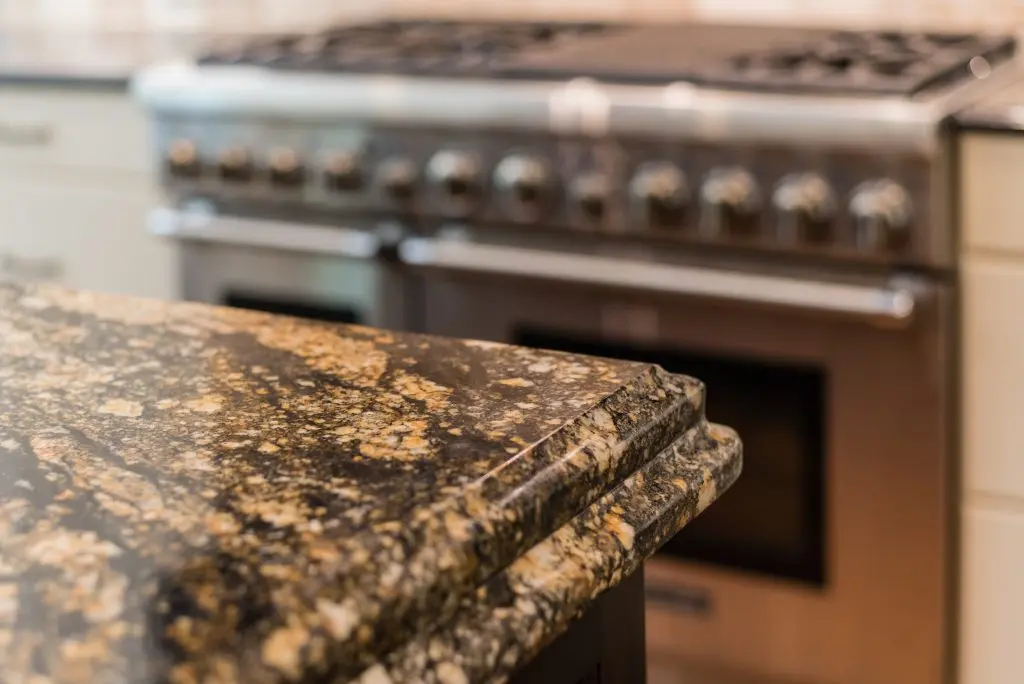
What granite colors work best for islands?
The best island color depends on the surrounding finishes.
White and cream granite
These colors can keep a large island bright and work particularly well with darker cabinets or warm wood.
Gray granite
Gray is versatile and can connect both warm and cool elements.
Black granite
Black granite creates strong contrast and works especially well with white, cream, or light gray cabinetry.
Brown and beige granite
Warm granite can complement oak, walnut, and other wood cabinets.
Popular granite options can include Santa Cecilia, Black Pearl, Steel Gray, White Ice, River White, and Dallas White. Availability and the exact appearance depend on the individual slab.
Does the island size affect the decision?
Yes.
A large island gives a dramatic granite pattern much more room to be visible.
A small island may not provide enough surface area for a highly active pattern to have the same impact.
Large islands also require careful slab planning. Sink cutouts, cooktop openings, seams, and overhangs can affect how much of the pattern remains visible.
This is why professional templating is important.
At Granite Depot of Columbia, we consider the dimensions and layout before fabrication so the granite can be positioned appropriately.
Can different granite finishes be used together?
Yes, but changing both the color and finish creates a much stronger contrast.
Granite can have finishes such as:
- polished;
- honed;
- leathered.
A polished surface has a glossy appearance and reflects more light.
A honed finish has a softer, matte appearance.
A leathered finish provides more visible texture.
If you are already using two different granite colors, keeping the finish consistent is often the easiest way to maintain visual cohesion.
If you want a more customized design, different finishes can work, but they should be chosen intentionally.
Does using two granite colors cost more?
Not automatically.
Granite at Granite Depot of Columbia starts at approximately $39 per square foot.
For example:
| Granite area | Starting material cost |
|---|---|
| 30 sq. ft. | $1,170 |
| 40 sq. ft. | $1,560 |
| 50 sq. ft. | $1,950 |
| 60 sq. ft. | $2,340 |
These are starting material costs only.
The final price depends on:
- selected granite;
- slab availability;
- total square footage;
- edge profile;
- sink cutouts;
- cooktop cutouts;
- seams;
- backsplash;
- fabrication;
- delivery;
- installation.
A premium or less readily available granite can have a higher price than the starting rate.
Choosing two colors can also require additional planning, but the number of colors alone does not determine the final project price.

Is granite still a good choice for a busy kitchen?
Yes. Granite is particularly practical for homeowners who want natural stone with strong resistance to everyday heat and wear.
It can handle normal kitchen activities such as:
- food preparation;
- hot cookware;
- frequent cleaning;
- daily spills;
- heavy countertop use.
Some granite varieties are more porous than others, so sealing requirements can vary.
We still recommend using trivets for extremely hot cookware and cutting boards for food preparation.
For homeowners looking at granite stores in Chester, SC, these practical considerations are just as important as choosing the right color.
Which option is right for your kitchen?
Choose matching granite if you want a consistent, calm appearance and do not want the island to dominate the room.
Choose contrasting granite if you want the island to become a focal point or if the kitchen needs more visual definition.
The most important rule is not that the countertops must match. They need to coordinate.
Look at the cabinets, flooring, backsplash, hardware, lighting, and the actual granite slabs together before making the decision.
For homeowners searching for granite stores in Chester, SC, seeing the full slabs in person can make this decision much easier.
Frequently Asked Questions
Does a granite island have to match the perimeter countertops?
No. The island can use the same granite for a seamless look or a different granite for contrast and visual interest.
Can you use two different granite colors in one kitchen?
Yes. Choose slabs that share at least one color or undertone, and use the backsplash or cabinetry to connect the two surfaces.
Is contrasting granite more expensive?
Not necessarily. Granite starts at approximately $39 per square foot at Granite Depot of Columbia. The final price depends on the specific slabs, square footage, fabrication, edges, cutouts, delivery, and installation.
How much does a 40-square-foot granite countertop cost?
At the $39 starting material price, 40 square feet would be approximately $1,560 in granite material before fabrication and installation.
How long does granite countertop installation take?
Most projects take approximately 2-3 weeks overall, with 7-10 business days for fabrication after templating and approximately 1-2 days for installation.
Does Granite Depot of Columbia serve Chester, SC?
Yes. Granite Depot of Columbia serves homeowners looking for granite stores in Chester, SC, providing granite selection, professional templating, custom fabrication, sink and appliance cutouts, edge finishing, delivery, and installation.
Granite Depot of Columbia
71 Berkshire Dr, Columbia, SC 29223
Phone: (803) 956-4555