


Yes — a waterfall edge is still worth it in 2026, but only in the right kitchen, with the right stone, and at the right budget. It hasn’t become dated. It has matured — used more selectively now than five years ago, and producing better results because of that selectivity.
The waterfall edge is one of the most visually dramatic things you can do with a stone countertop. It’s also one of the most expensive and technically demanding. Understanding both sides of that equation before committing is what separates a result you’ll love from one that feels like an overpriced decision in retrospect.
At Granite Depot of Columbia, we fabricate and install countertops in Cheraw, SC and throughout the Midlands region including waterfall edge projects regularly. Here’s the honest breakdown.
What exactly is a waterfall edge — and how is it made?
A waterfall edge is a countertop configuration where the stone continues vertically down the side of an island or cabinet, from the countertop surface to the floor. The result is a continuous, uninterrupted stone surface that wraps the island completely — hence the name.
Fabricating a waterfall edge requires precise mitered cuts where the horizontal surface meets the vertical panel, typically at 45 degrees. On a veined stone — marble, quartzite, or a figured granite — the miter joint needs to align the stone’s movement continuously across the seam to create the illusion of a single flowing surface. That alignment is both the most technically demanding part of the fabrication and the most visually rewarding when executed well.
On uniform stones like Absolute Black granite or solid-tone quartz, the miter is simpler because continuity comes from color consistency rather than vein matching. Both approaches work — but they produce very different visual results.
For countertops in Cheraw, SC homeowners planning a waterfall island, the stone selection decision is more consequential than in almost any other countertop application. Here’s why.
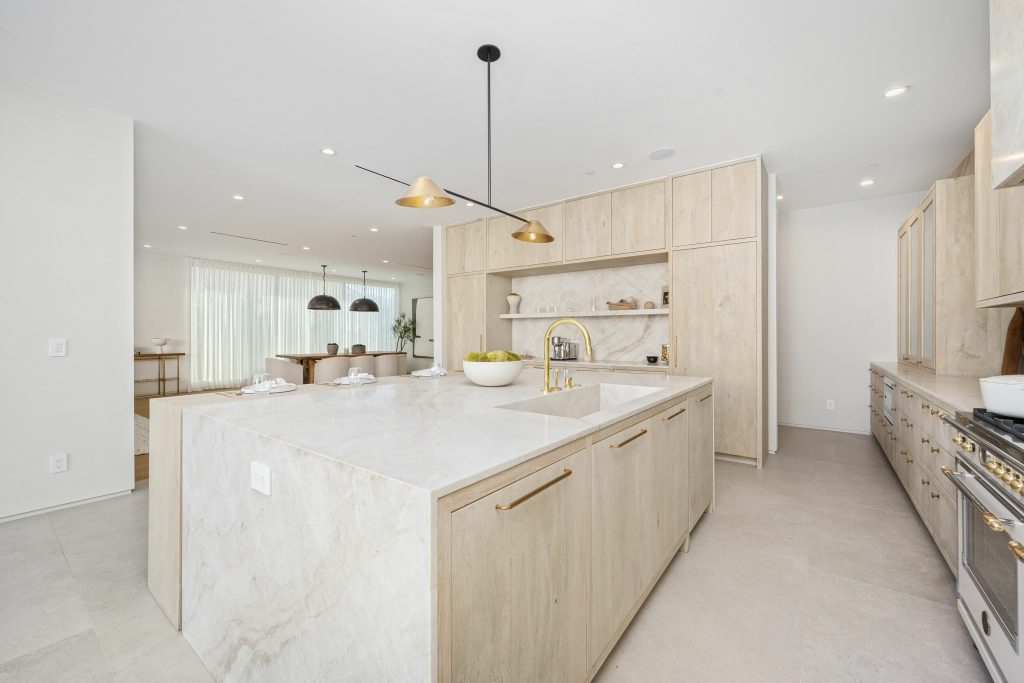
Which stones work best for a waterfall edge?
Stone selection is the single most important decision in a waterfall edge project — more than cabinet style, kitchen size, or budget.
Marble with bold directional veining is the most spectacular waterfall material when executed well. Calacatta Gold, Statuario Venato, and Calacatta Borghini create a dramatic continuous flow from horizontal to vertical that no other material fully replicates. A well-matched Calacatta Gold waterfall island is among the most striking features possible in a residential kitchen. Marble starts at $65 per square foot at Granite Depot of Columbia in 2026 — a waterfall island in a premium marble variety typically runs $3,000 to $7,000 for the island surface alone depending on size and slab selection.
Quartzite delivers similar drama with superior hardness. Taj Mahal, Super White, and Patagonia quartzite are particularly well suited to waterfall applications because their movement is directional enough to read beautifully across the miter. In the Columbia, SC area, quartzite typically starts around $75 per square foot installed in 2026 for mid-range varieties.
Quartz is the most controllable choice. Brands like Cambria, Silestone, and Caesarstone produce engineered slabs with consistent, repeatable patterns — which means vein matching across the miter is more predictable than with natural stone. For homeowners who want the waterfall aesthetic with less fabrication risk, quartz starting at $50 per square foot at Granite Depot of Columbia in 2026 is a strong option.
Granite works best for waterfall edges on stones with strong directional movement. Fusion White, Titanium, and Blue Bahia have enough visual energy to make a waterfall edge compelling. Quiet, uniform granites don’t gain much from a waterfall treatment — the added cost isn’t justified by the visual return. Granite starts at $39 per square foot at Granite Depot of Columbia in 2026.
| Material | Waterfall Suitability | Best Varieties | Starting Price 2026 |
|---|---|---|---|
| Marble | Excellent | Calacatta Gold, Statuario Venato | From $65/sq ft* |
| Quartzite | Excellent | Taj Mahal, Super White, Patagonia | From ~$75/sq ft |
| Quartz | Very good | Cambria Brittanicca, Silestone Statuario | From $50/sq ft* |
| Granite | Good — busy stones | Fusion White, Titanium, Blue Bahia | From $39/sq ft* |
*At Granite Depot of Columbia in 2026
How much does a waterfall edge add to the total project cost?
A waterfall edge adds cost in two ways — more stone and more fabrication time.
More stone. A single-sided waterfall panel on an island four feet tall requires an additional 12 to 16 square feet of stone beyond the countertop surface. A two-sided waterfall doubles that. For a premium marble at $100 to $140 per square foot installed, the additional stone cost alone adds $1,200 to $4,500 to the project.
More fabrication. Mitered cuts, vein matching, and precise alignment add fabrication time and skill beyond a standard countertop installation. Expect fabrication and installation costs to run $500 to $1,500 higher than a comparable non-waterfall project depending on complexity and stone selection.
In total, adding a waterfall edge to a kitchen island typically adds $2,000 to $5,500 compared to a standard edge treatment — with the range driven almost entirely by stone selection and island size. For a straightforward quartz waterfall on a modest island, the addition is closer to $1,500 to $2,500. For a premium marble two-sided waterfall on a large island, it can reach $6,000 or more.
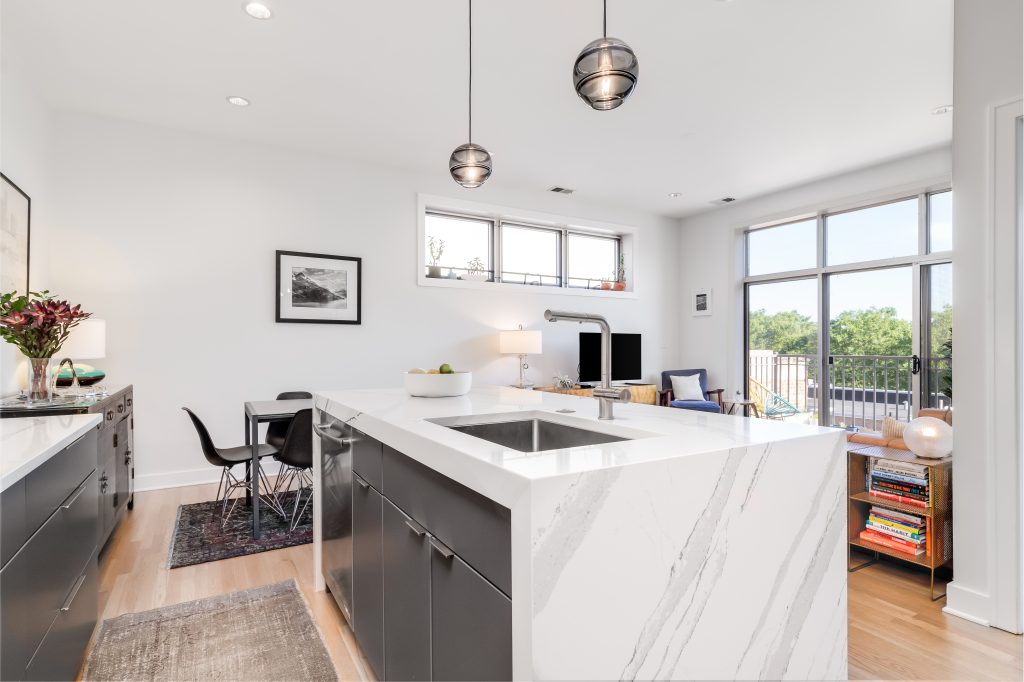
When is a waterfall edge worth it — and when isn’t it?
A waterfall edge is worth it when the island is a genuine focal point, the stone has enough visual interest to carry a vertical surface, and the kitchen has open sightlines where the feature is seen from multiple viewing angles. In an open-plan home where the kitchen is visible from the living and dining areas, a well-executed waterfall island reads as an architectural feature rather than a countertop detail.
It’s less worth it when the stone is too quiet to justify the cost, the island is small, or the waterfall panel faces a wall and is rarely seen straight-on. A two-sided waterfall on a small island adds cost without proportional visual return. A one-sided waterfall on an island that backs up to a wall produces one visible panel — which may or may not justify the fabrication premium.
The kitchens where waterfall edges work best consistently share a few characteristics — generous island size, open sightlines, a stone with directional movement, and cabinet colors that allow the stone to lead visually. When those elements align, the result is genuinely exceptional.
For anyone finalizing plans for countertops in Cheraw, SC, Granite Depot of Columbia serves Cheraw and Chesterfield County from our Columbia, SC location. Whether you’re planning a full waterfall island in Calacatta marble or evaluating whether the investment makes sense for your specific kitchen, our team walks through stone selection, fabrication requirements, and realistic cost expectations before any commitment is made. Most projects are completed within two to three weeks from template to installation. Reach us at (803) 956-4555 or visit us at 71 Berkshire Dr, Columbia, SC 29223.
Frequently Asked Questions
How much does a waterfall edge countertop cost in 2026?
Adding a waterfall edge typically adds $2,000 to $5,500 to a kitchen island project at Granite Depot of Columbia compared to a standard edge treatment, depending on stone selection and island size. Quartz waterfall projects run toward the lower end of that range. Premium marble or quartzite two-sided waterfall islands run significantly higher. The addition breaks down into extra stone for the vertical panels and higher fabrication costs for mitered cuts and vein matching.
Which stone is best for a waterfall edge in 2026?
Marble and quartzite with strong directional veining produce the most dramatic waterfall results — Calacatta Gold, Statuario Venato, Taj Mahal quartzite, and Super White quartzite are the most requested varieties for waterfall applications. Quartz from Cambria and Silestone is the most predictable option for consistent vein matching across the miter joint. At Granite Depot of Columbia, all four materials are available for waterfall projects starting at their respective base prices in 2026.
How long does a waterfall edge installation take?
Most projects at Granite Depot of Columbia including waterfall edges are completed within two to three weeks from template to installation. Waterfall projects may run toward the longer end of that window due to additional fabrication complexity in mitered cuts and vein alignment.
Is a waterfall edge still on trend in 2026?
Yes — but it has matured from a broad trend into a more selective design choice. The kitchens using waterfall edges in 2026 tend to be more intentional about stone selection and viewing angles than earlier applications. Used in the right context with the right stone, it remains one of the most impactful design moves available in kitchen design.
Does Granite Depot of Columbia serve Cheraw, SC?
Yes. We operate from one location — 71 Berkshire Dr, Columbia, SC 29223 — and serve homeowners looking for countertops in Cheraw, SC and throughout Chesterfield County regularly. We have no separate office in Cheraw, but our team completes projects there consistently. Call us at (803) 956-4555 to schedule a visit or get a quote.