

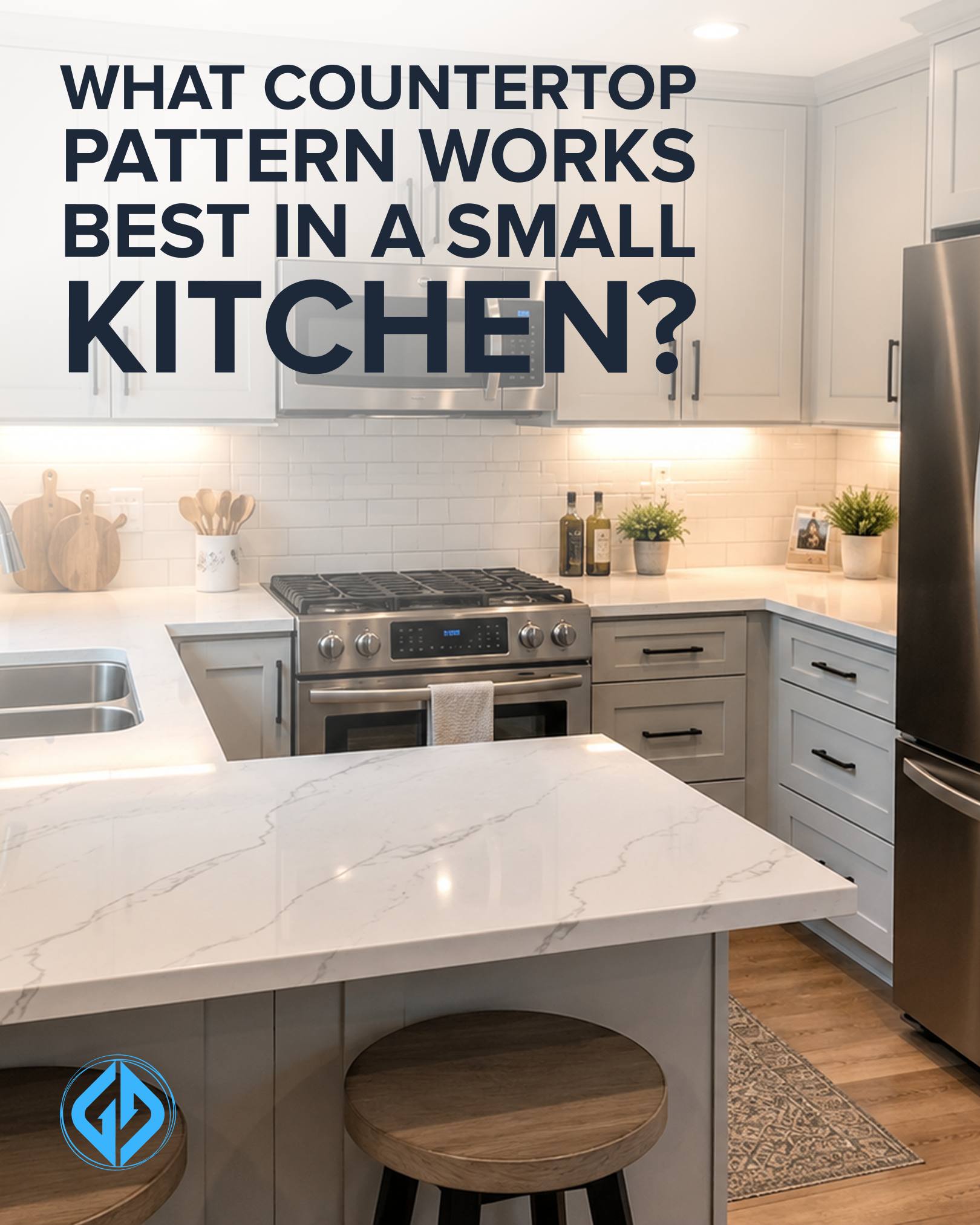
In a small kitchen, subtle or medium-scale countertop patterns usually work best because they add movement without visually crowding the room. Light backgrounds, soft veining, low-contrast granite, and controlled quartz patterns can make a compact kitchen feel more open, while extremely bold veins or busy multicolor patterns may make short countertop runs feel fragmented.
That does not mean a small kitchen must be boring. A dramatic surface can still work if the cabinetry, backsplash, and flooring stay simple. The key is scale: a pattern should have enough room to develop across the visible countertop instead of being broken into several unrelated pieces.
At Granite Depot of Columbia, we help homeowners choosing kitchen countertops in Barnwell, SC compare granite, quartz, marble, and quartzite based on cabinet color, natural light, countertop layout, and the actual size of the room before fabrication begins.
Why do subtle patterns usually work better in small kitchens?
Subtle patterns usually work better because they create continuity instead of dividing the countertop visually.
Small kitchens often have several short sections of countertop separated by sinks, ranges, refrigerators, and corners. If the stone has extremely large veins, one section may show a bold line while another section looks almost plain.
That can make the layout feel inconsistent.
Fine or medium-scale movement creates a more even appearance across multiple countertop runs.
This is especially useful in galley kitchens, compact L-shaped kitchens, and older homes where counter space is divided into smaller sections.
Soft movement also allows other design elements—cabinet doors, backsplash, hardware, or flooring—to remain visible instead of competing with the countertop.

Are light countertops always better in a small kitchen?
No, but light countertops usually make a small kitchen feel brighter and more open.
Warm white, cream, light gray, greige, and pale beige reflect more light than dark charcoal or black stone. That can be useful when the kitchen has limited windows or lower ceilings.
However, contrast matters too.
A completely white kitchen with white cabinets, white walls, white backsplash, and nearly solid white countertops can feel flat rather than spacious. A light surface with subtle gray or beige movement often works better because it adds depth without making the room busy.
Dark countertops can still look excellent in a small kitchen when paired with lighter cabinets and good lighting.
For kitchen countertops in Barnwell, SC, we usually recommend comparing the countertop sample in the actual lighting conditions rather than assuming “light is always right.”
Which granite patterns work best in small kitchens?
Granite with distributed, relatively consistent mineral movement is often the easiest to use in a compact space.
Depending on current slab availability, homeowners may consider granite such as Luna Pearl, New Caledonia, Dallas White, Santa Cecilia, River White, White Ice, or Black Pearl.
Each creates a different visual effect.
Luna Pearl and New Caledonia have more evenly distributed mineral patterns, which can help separate countertop sections feel connected.
Dallas White keeps the surface light while adding enough natural variation to avoid looking flat.
River White and White Ice can create more noticeable movement, but the slab should be laid out carefully so the strongest veins do not disappear into a sink or become awkwardly cut off.
Black Pearl can work in a small kitchen when paired with white or light wood cabinets, especially if the room has enough natural and artificial light.
At Granite Depot of Columbia, granite starts at approximately $39 per square foot.
Does quartz work better than granite in a small kitchen?
Quartz can be easier to control visually because its patterns are more predictable.
Engineered quartz manufacturers such as Cambria, Silestone, Caesarstone, MSI Quartz, and Vicostone offer everything from almost-solid surfaces to dramatic Calacatta-style designs.
In small kitchens, we often prefer:
- warm white quartz;
- subtle gray veining;
- soft beige or greige movement;
- fine marble-inspired patterns;
- low-contrast designs.
This gives the kitchen texture without making each countertop section look disconnected.
Quartz also has another practical advantage: it is non-porous and does not require routine sealing.
At Granite Depot of Columbia, quartz starts at approximately $50 per square foot.
That makes it a strong option for homeowners who want a controlled pattern and simple daily maintenance.

Can bold veining work in a small kitchen?
Yes, but it works best when the countertop has at least one uninterrupted area where the pattern can be seen properly.
A small island is often the best place for stronger veining.
If the perimeter counters are simple and the backsplash is quiet, a bold marble-look quartz or dramatic natural stone on the island can create a focal point without overwhelming the whole kitchen.
The problem comes when large veins are spread across many small countertop sections.
Imagine a strong diagonal vein that gets cut at the sink, restarts beside the range, and disappears again near the refrigerator. The pattern may feel accidental instead of intentional.
For this reason, large-scale movement is usually easier to use on a single island or long straight run than across a fragmented small-kitchen layout.
Is marble a good choice for a small kitchen?
Marble can look beautiful in a small kitchen because its lighter colors and natural veining can make the room feel elegant without requiring a huge amount of material.
Carrara is often easier visually because its gray-white background and softer movement work well across short sections.
Calacatta and Statuario can be more dramatic, with larger veins and brighter white backgrounds. They may work best when one clear countertop section is intended to become the visual feature.
Crema Marfil brings in warmer beige tones and can coordinate well with wood or cream cabinetry.
At Granite Depot of Columbia, marble starts at approximately $65 per square foot.
The bigger consideration is maintenance. Marble can etch from lemon juice, vinegar, wine, tomatoes, and other acids, so it is better suited to homeowners who are comfortable with a natural patina over time.
What about quartzite in a small kitchen?
Quartzite can work extremely well when you want natural stone with stronger movement than many granites.
Light quartzites with cream, gray, beige, or gold veining can brighten a compact kitchen while still creating a high-end focal point.
However, quartzite can also have very large dramatic veins, so slab layout becomes especially important in a smaller room.
A small sample does not show the full scale of the pattern.
For homeowners working with kitchen countertops in Barnwell, SC, we recommend viewing the actual slab whenever possible, especially when the material has long directional movement.
At Granite Depot of Columbia, quartzite pricing is available upon request because final cost depends heavily on the selected slab.
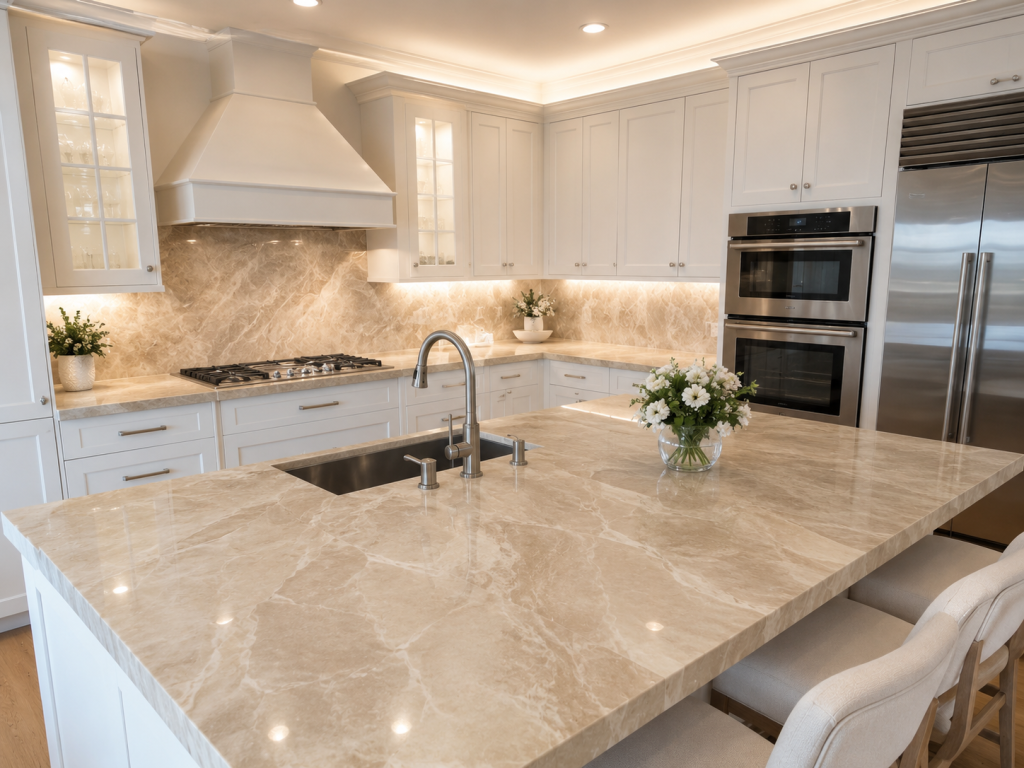
Should the countertop pattern match the backsplash?
No. The countertop and backsplash should coordinate, but they do not need equal levels of pattern.
In a small kitchen, one strong pattern is usually enough.
If the countertop has visible veining, a simple backsplash—such as warm white subway tile or large-format neutral tile—helps the room feel cleaner.
If the countertop is subtle, the backsplash can carry more texture or color.
This avoids the common mistake of combining:
- busy granite;
- patterned backsplash;
- strongly grained cabinets;
- detailed flooring.
Each material may look attractive alone, but together they can make a compact kitchen feel visually crowded.
Which countertop pattern is easiest to live with day to day?
Medium-patterned surfaces are often the most forgiving because they hide crumbs, water spots, and minor residue better than extremely solid or extremely dramatic materials.
Very solid dark countertops can show fingerprints and dust.
Very solid white countertops can make dark crumbs or spills obvious.
Moderately patterned granite or lightly veined quartz can disguise both without looking busy.
That balance is one reason we often recommend mid-level movement for active small kitchens.
How much do countertops for a small kitchen cost?
The final cost depends more on material, square footage, slab selection, cutouts, edge profile, and fabrication than on pattern alone.
At Granite Depot of Columbia, current starting prices are:
| Material | Starting price |
|---|---|
| Granite | From $39/sq. ft. |
| Quartz | From $50/sq. ft. |
| Marble | From $65/sq. ft. |
| Quartzite | Price available upon request |
A small kitchen can sometimes be more budget-friendly because it requires less material, but irregular layouts may still require detailed fabrication and several separate pieces.
Sink cutouts, cooktop openings, backsplashes, edge profiles, and seam placement all affect the complete quote.
How long does countertop fabrication and installation take?
Most Granite Depot of Columbia projects take approximately 2–3 weeks overall.
After final templating, fabrication typically requires 7–10 business days. During this stage, we plan the slab layout, cut each piece, create sink and cooktop openings, fabricate the edge profile, and prepare the countertops for installation.
Installation usually takes approximately 1–2 days for a standard project.
Granite Depot of Columbia provides material selection, professional templating, custom fabrication, sink and appliance cutouts, edge finishing, delivery, and professional installation for homeowners in Barnwell, SC and the surrounding area.