

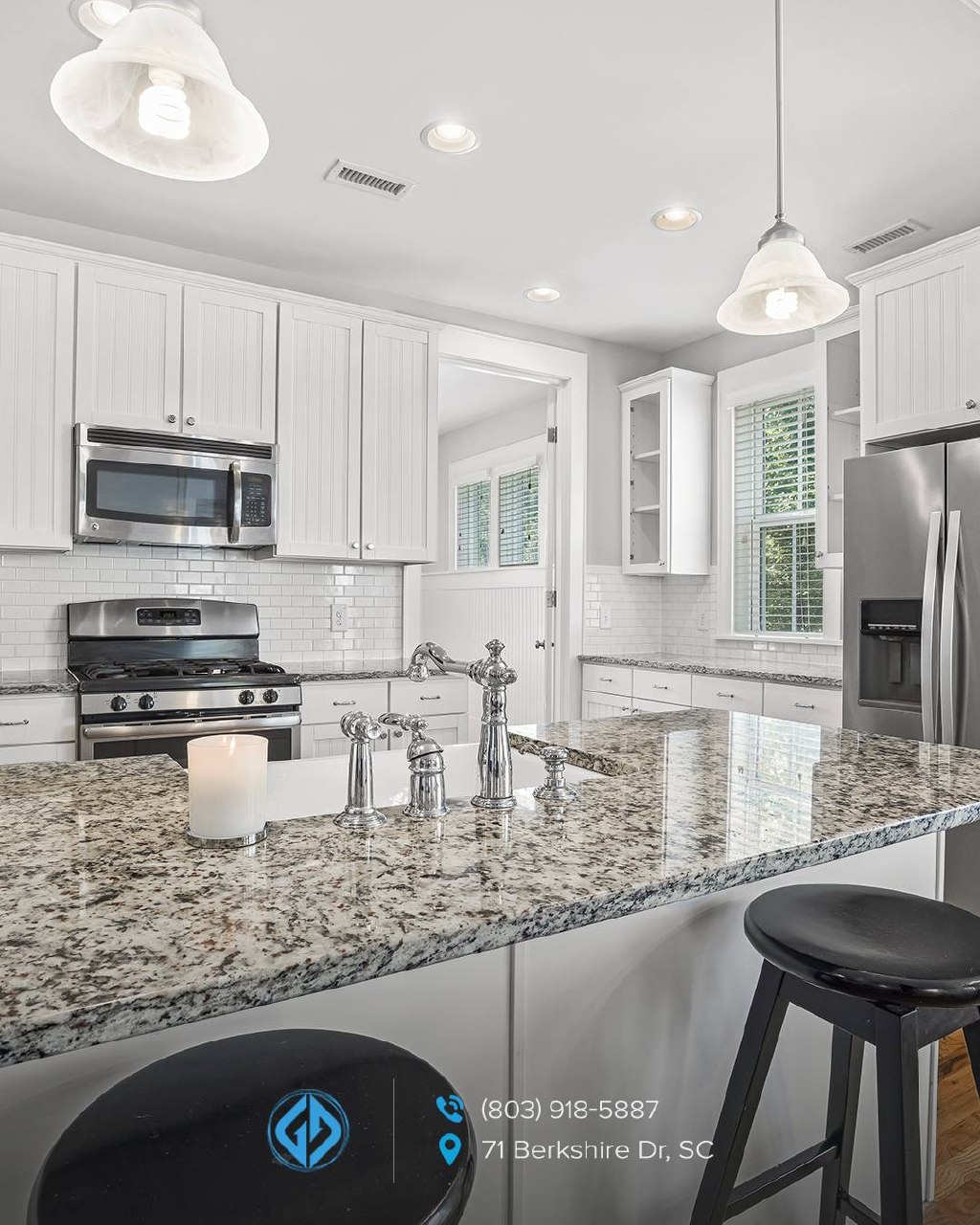
Granite looks different under natural light than it does under artificial light — and that’s not a defect, a disappointment, or a sign that something went wrong. It’s exactly how natural stone is supposed to behave. The minerals in granite — quartz, feldspar, mica, and others — each reflect and absorb light differently depending on its direction, intensity, and color temperature. The result is a surface that shifts subtly across the day, sometimes dramatically, in ways that no other countertop material replicates.
Understanding why this happens — and how to use it to your advantage during material selection — is one of the most practical things a homeowner can know before committing to a stone. At Granite Depot of Columbia, we fabricate and install granite countertops in Cheraw, SC and throughout the Midlands region, and the lighting question comes up consistently. Here’s the full explanation.
Why does granite behave differently under different light sources?
Granite is a multi-mineral stone, and each mineral responds to light in its own way. Quartz crystals in granite are translucent — they transmit and scatter light rather than simply reflecting it, which creates depth and an almost three-dimensional quality in the stone. Feldspar reflects light more directly and contributes to the stone’s base color. Mica — the small metallic flecks visible in many granites — acts almost like a mirror, catching light at specific angles and producing the sparkle that makes certain stones appear to glow.
Natural light is full-spectrum and directional. It changes color temperature throughout the day — cooler and bluer in the morning, warmer and more golden in the afternoon, dramatically warmer at sunset. As that light shifts, it hits the granite’s mineral structure from different angles and at different wavelengths, which is why the same stone can look almost silver-white at noon and distinctly warm and golden by late afternoon.
Artificial light is fixed in both direction and color temperature. LED lighting — the most common kitchen lighting in 2026 — typically sits between 2700K and 4000K on the color temperature scale. Warm LEDs (2700K–3000K) amplify warm tones in granite and can make cool-toned stones read differently than they did in the showroom. Cool white LEDs (3500K–4000K) bring out gray and blue undertones and can make warm granites appear more neutral than expected.

Which granite varieties show the most dramatic light variation?
Not all granites shift equally. The degree of light variation depends on mineral composition, finish, and color tone.
Mica-rich granites show the most dramatic light behavior. Black Pearl, Volga Blue, and Ubatuba are classic examples — under direct light they appear to shimmer and shift, revealing metallic depth that completely disappears under diffuse or low light. Homeowners who choose these stones specifically for that sparkle sometimes find that it’s less visible in their kitchen than it was in the showroom — usually because the showroom used focused directional lighting designed to showcase the effect.
White and light gray granites — Kashmir White, Bianco Romano, River White — show the most color temperature sensitivity. Under warm artificial light, their background tone shifts noticeably warmer. Under cool natural daylight, they read as crisper and cooler. This is why Kashmir White, one of the most popular selections for granite countertops in Cheraw, SC and throughout South Carolina, can look slightly different in photographs taken at different times of day.
Dark, uniform granites like Absolute Black and Steel Grey show the least light variation — their mineral structure is less reflective and their color is consistent enough that lighting changes produce only subtle differences. This is one reason these stones are popular in kitchens with complex or variable lighting conditions.
Highly figured granites — Fusion White, Titanium, Blue Bahia — fall somewhere in between. Their movement and mineral variation means different parts of the slab catch light differently, which can make the stone appear to have more depth and energy under direct natural light than under flat artificial illumination.
| Granite Type | Light Sensitivity | Best Lighting | Starting Price 2026 |
|---|---|---|---|
| Mica-rich (Black Pearl, Volga Blue) | High — strong sparkle effect | Directional lighting | From $39/sq ft* |
| White/light gray (Kashmir White) | Medium — color temp shift | Natural + warm LED | From $39/sq ft* |
| Dark uniform (Absolute Black) | Low — very consistent | Any lighting | From $39/sq ft* |
| Highly figured (Fusion White) | Medium-high — depth varies | Natural daylight | From $55/sq ft |
*At Granite Depot of Columbia in 2026
Why does granite look different in the showroom than at home?
This is one of the most common questions we hear after installation, and the answer is almost always lighting. Showrooms are designed to make stone look its best — typically with a combination of focused overhead lighting, natural light from large windows, and display angles that maximize the stone’s depth and movement. Most home kitchens don’t replicate those conditions exactly, which means the stone may read slightly differently once installed.
The finish amplifies this effect. A polished granite under focused showroom lighting is catching every available light source simultaneously — the result is maximum color depth and sparkle. The same stone under a single overhead fixture in a kitchen without undercabinet lighting and without much natural light will look flatter and less vivid. The stone hasn’t changed. The lighting conditions have.
This is why we consistently advise homeowners to view stone samples at home — not just in the showroom — before committing. Bring the sample into your kitchen at different times of day. Hold it under your cabinet lighting. Look at it in morning light and afternoon light. The reading you get from those conditions is much closer to what you’ll live with than anything you see in a showroom.
How should homeowners use this knowledge during stone selection?
The practical application is straightforward. When selecting granite, always evaluate the stone under conditions as close to your actual kitchen as possible — not just under showroom lighting. Ask the fabricator to show you the slab both under direct focused light and under more diffuse conditions. Note whether the stone you’re drawn to is mica-rich and sparkle-dependent, or whether its beauty comes from movement and color that will read consistently across lighting conditions.
At Granite Depot of Columbia, we serve Cheraw, SC from our Columbia, SC location. Granite starts at $39 per square foot in 2026, and we also offer granite packages that include fabrication, edge finishing, cutouts, and installation at a more favorable overall price point. For anyone finalizing decisions on granite countertops in Cheraw, SC, our team can walk you through how specific slabs behave under different lighting conditions before any commitment is made. Reach us at (803) 956-4555 or visit us at 71 Berkshire Dr, Columbia, SC 29223.

Frequently Asked Questions
Why does granite look different under natural vs. artificial light?
Granite contains multiple minerals — quartz, feldspar, and mica — each of which reflects and absorbs light differently. Natural light changes color temperature and direction throughout the day, causing the stone’s appearance to shift. Artificial light is fixed in both direction and color temperature, which is why the same granite can look noticeably different under morning sunlight versus evening LED lighting.
How much do granite kitchen countertops cost in Cheraw, SC in 2026?
In the Columbia, SC area, granite countertops typically range from $50 to $100 per square foot installed in 2026. At Granite Depot of Columbia, granite kitchen countertops in Cheraw, SC start at $39 per square foot in 2026. For a standard kitchen of 40 to 50 square feet, most projects fall between $2,000 and $5,500 fully installed depending on granite grade, edge profile, and layout complexity.
What LED color temperature works best for granite countertops?
Warm LEDs at 2700K to 3000K work best for most warm and neutral granites — Kashmir White, Santa Cecilia, Giallo Ornamental. Cooler LEDs at 3500K to 4000K suit very white or cool-toned selections better. Undercabinet lighting at a consistent color temperature is the single most impactful lighting addition for any granite kitchen.
How long does granite countertop installation take at Granite Depot of Columbia?
Most projects are completed within two to three weeks from first contact to installed countertops. Fabrication runs seven to ten business days after the template appointment, and installation is completed in one to two days for most standard kitchens.
Does Granite Depot of Columbia serve Cheraw, SC?
Yes. We operate from one location — 71 Berkshire Dr, Columbia, SC 29223 — and serve homeowners looking for granite countertops in Cheraw, SC regularly. We have no separate office in Cheraw, SC, but our team completes projects there consistently. Call us at (803) 956-4555 to schedule a showroom visit or get a quote.