

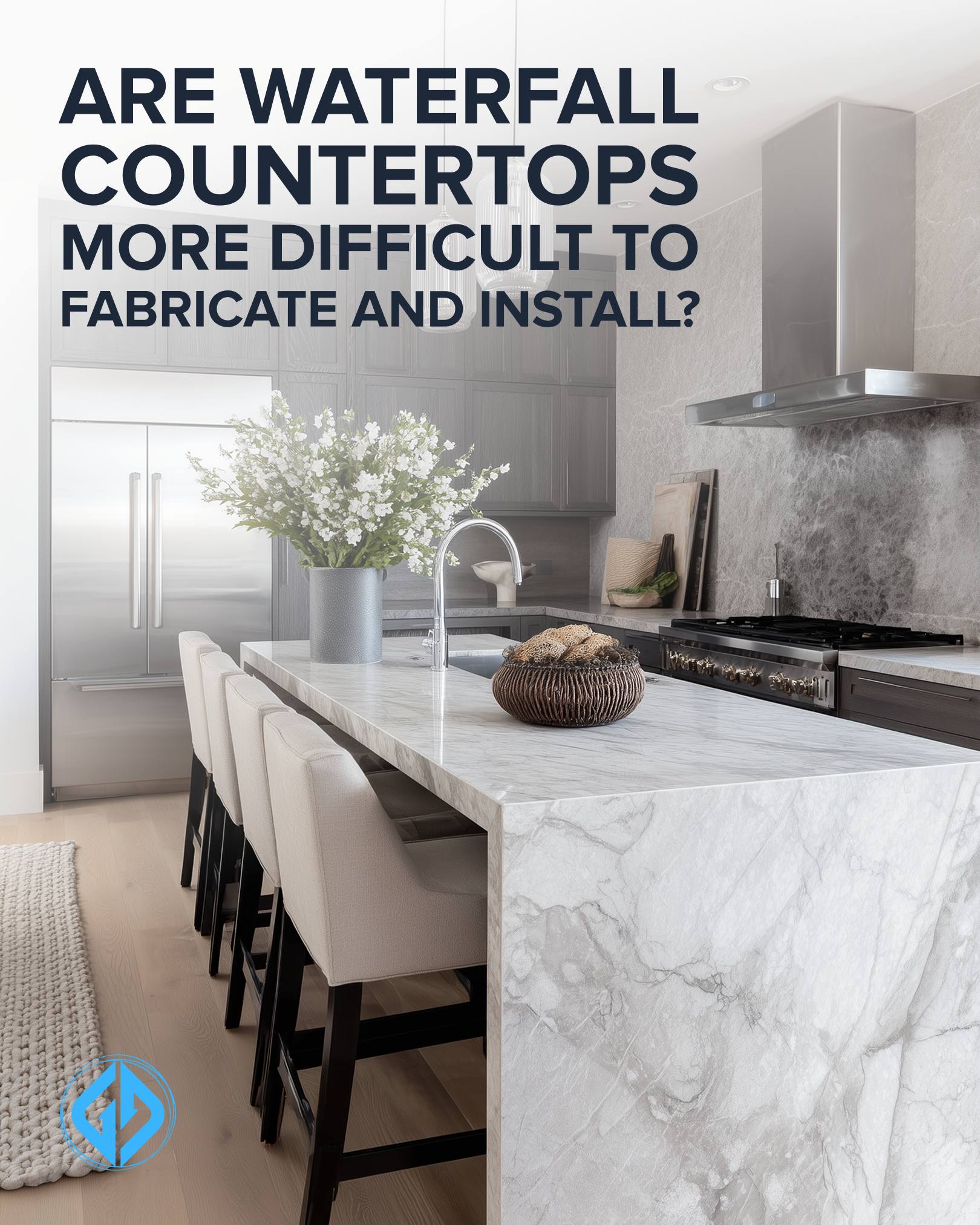
Yes — waterfall countertops are significantly more difficult to fabricate and install than a standard countertop, and the difficulty isn’t marketing language used to justify the higher cost. It reflects genuine technical demands at every stage of the process — from slab selection through final installation — that don’t apply to a conventional flat countertop with a simple edge.
Understanding what actually makes a waterfall edge harder to execute is useful for any homeowner considering the feature, both to set realistic budget expectations and to evaluate whether a fabricator has the specific experience this kind of project requires.
At Granite Depot of Columbia, we fabricate and install countertops in Manning, SC and throughout the Midlands region including waterfall edge projects regularly. Here’s what actually goes into building one correctly.
What makes the slab selection process harder for a waterfall edge?
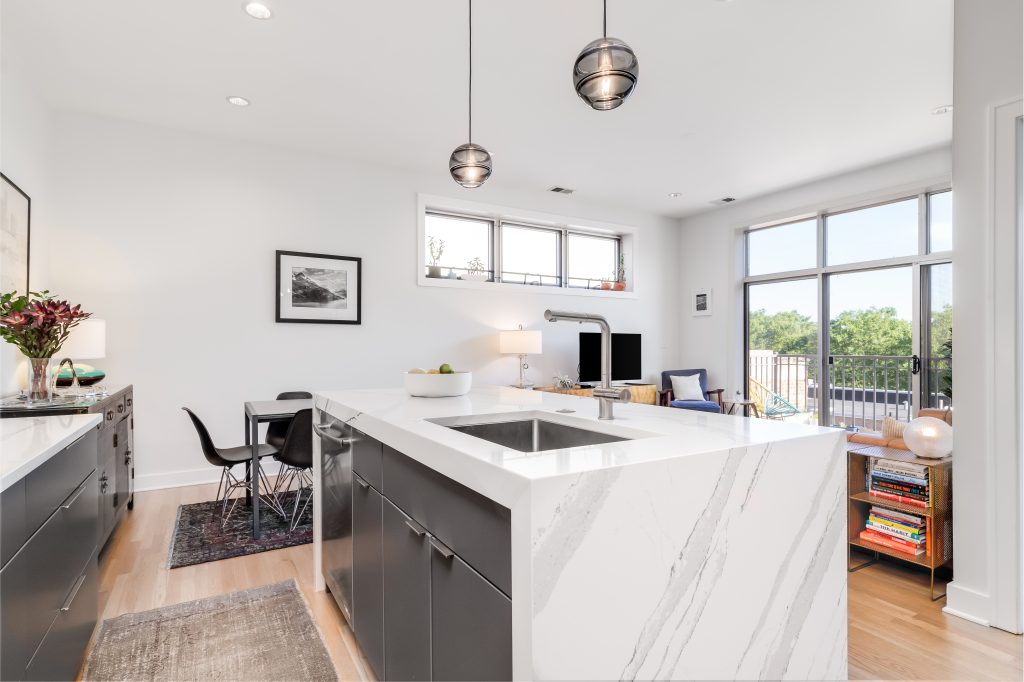
Slab selection for a waterfall countertop requires solving a problem that doesn’t exist with a standard countertop — the pattern needs to continue convincingly from the horizontal surface to the vertical panel, which means the slab itself needs to be evaluated differently from the start.
For a standard countertop, the fabricator is selecting a slab and cutting pieces from wherever the pattern works best within that slab. For a waterfall edge, the horizontal and vertical sections need to come from positions on the slab where the veining or movement will align or flow naturally across the miter joint. This requires mapping the cut layout against the slab’s specific pattern before any cutting begins — a planning step that adds time and requires genuine skill in reading how a pattern will behave once it’s cut and reoriented.
On a heavily veined stone like Calacatta Gold marble or Patagonia quartzite, this mapping process is the single most consequential decision in the entire project. A poorly planned cut layout produces a waterfall where the pattern visibly breaks or mismatches at the miter — a result that’s difficult to correct after fabrication and impossible to fix without replacing the stone.
For countertops in Manning, SC customers considering a waterfall island, this is the first place where fabricator experience genuinely matters — not every shop has staff with the specific skill of reading slab patterns for waterfall continuity.
Why is the miter cut itself more technically demanding?
The miter joint — where the horizontal countertop surface meets the vertical waterfall panel — is typically cut at a 45-degree angle on both pieces so they join to form a continuous corner. This cut needs to be extremely precise, because any inconsistency in the angle creates a visible gap or misalignment at the seam.
Standard countertop edges are cut with relatively forgiving tolerances — a straight eased or beveled edge has more room for minor variation without visible consequence. A mitered waterfall joint has essentially no tolerance for error. The two 45-degree cuts need to match within a fraction of a millimeter to create a seamless-looking corner, and this level of precision requires both high-quality CNC cutting equipment and an experienced operator who understands how different stone densities respond to the cutting process.
Stone density adds another layer of difficulty. Quartzite, at Mohs 7 and above, is harder to cut precisely than granite, and granite is harder to cut precisely than marble. Each material requires different blade speeds, cutting pressures, and cooling approaches to achieve a clean, accurate miter without chipping or cracking the stone at the cut edge — which is a real risk given how thin and exposed the cut surface is at a 45-degree angle.
What makes the installation of a waterfall panel harder than a standard countertop?
Installation day for a waterfall countertop involves structural and positioning challenges that a standard flat installation doesn’t.
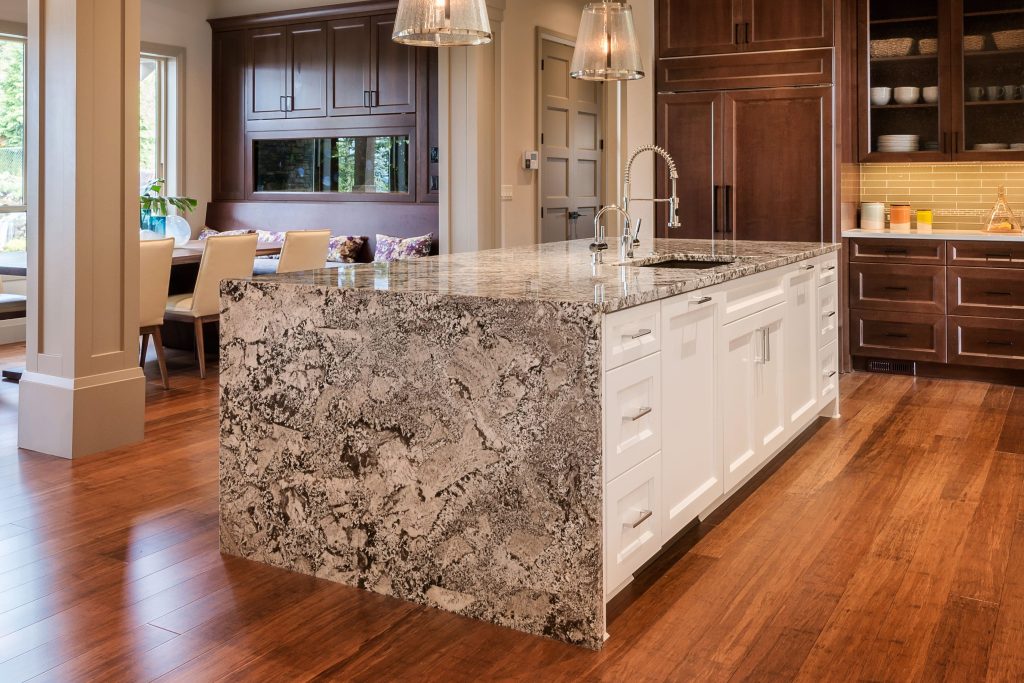
Weight and positioning are the first challenge. A waterfall panel needs to be moved into position vertically and bonded to the side of the cabinet structure — a process that requires more hands, more careful equipment, and more precise positioning than setting a flat countertop piece onto a cabinet top. The panel needs to be held in exact position while the bonding adhesive cures, often requiring temporary bracing or clamping systems to maintain alignment.
Seam alignment under gravity is the second challenge. Unlike a horizontal seam where gravity helps keep two pieces aligned and pressed together, a vertical waterfall seam has gravity working against the installation — the panel wants to shift downward or outward during the bonding process. Experienced installers use specific clamping and bracing techniques to counteract this, but it requires more attention and more time than a standard countertop seam.
Color-matched seam adhesive needs to be mixed and applied precisely to make the miter joint as visually seamless as possible. This is true of any stone seam, but the visibility of a waterfall miter — typically at eye level on a kitchen island, viewed from multiple angles — makes seam quality more consequential than a perimeter counter seam that’s rarely scrutinized closely.
Structural support underneath the vertical panel needs to be confirmed before installation. The cabinet structure beneath a waterfall panel needs to support not just the weight of the panel itself but the stress of the bonding process during cure time. This is part of why cabinet readiness assessment matters even more for waterfall projects than for standard installations.
Does this added difficulty translate directly into cost?
Yes — the technical demands described above are exactly what’s reflected in waterfall edge pricing, not arbitrary upcharging. Adding a waterfall edge to a kitchen island typically adds $2,000 to $5,500 to the project compared to a standard edge treatment at Granite Depot of Columbia, depending on stone selection and island size.
That additional cost breaks down into two categories that map directly to the fabrication challenges above. More stone is required — a single-sided waterfall panel on a four-foot-tall island needs an additional 12 to 16 square feet of material beyond the countertop surface, which adds material cost proportional to the stone’s price per square foot. More skilled labor and time is required — the slab mapping, precise mitering, and careful installation process all take meaningfully longer than a standard countertop, and that time is reflected in fabrication and installation labor costs.
Granite starts at $39 per square foot at Granite Depot of Columbia in 2026, quartz at $50, and marble at $65 — and waterfall applications are available across all of these materials with the added fabrication premium reflecting the genuine additional skill and time involved rather than an inflated markup.
| Fabrication Stage | Standard Countertop | Waterfall Edge |
|---|---|---|
| Slab selection | Choose best section for pattern | Map pattern continuity across miter |
| Edge cutting | Forgiving tolerance | Precise 45° miter, near-zero tolerance |
| Installation | Set on cabinet top | Vertical positioning + bonding under gravity |
| Seam visibility | Often minimal | High — eye-level, multiple viewing angles |
What should you ask a fabricator before committing to a waterfall project?
Given the added technical demands, the questions worth asking shift somewhat from a standard countertop project. Ask specifically whether the company has completed waterfall edge projects before — not just standard countertops — and ask to see photos of completed waterfall work, paying particular attention to how cleanly the miter joints read.
Ask how the slab will be selected and whether the cut layout will be planned and shown to you before cutting begins, particularly for a heavily veined stone where pattern continuity matters most. Confirm the fabrication and installation timeline specifically for the waterfall portion, since it typically adds one to three business days to fabrication and additional time to installation day compared to a standard project.
For anyone planning a waterfall edge project, countertops in Manning, SC included, Granite Depot of Columbia serves Manning and Clarendon County from our Columbia, SC location and completes waterfall edge projects across granite, quartz, marble, and quartzite regularly. Most waterfall projects are completed within two to three weeks from template to installation, with the waterfall-specific fabrication work falling within that standard window for most island sizes. Reach us at (803) 956-4555 or visit us at 71 Berkshire Dr, Columbia, SC 29223.