

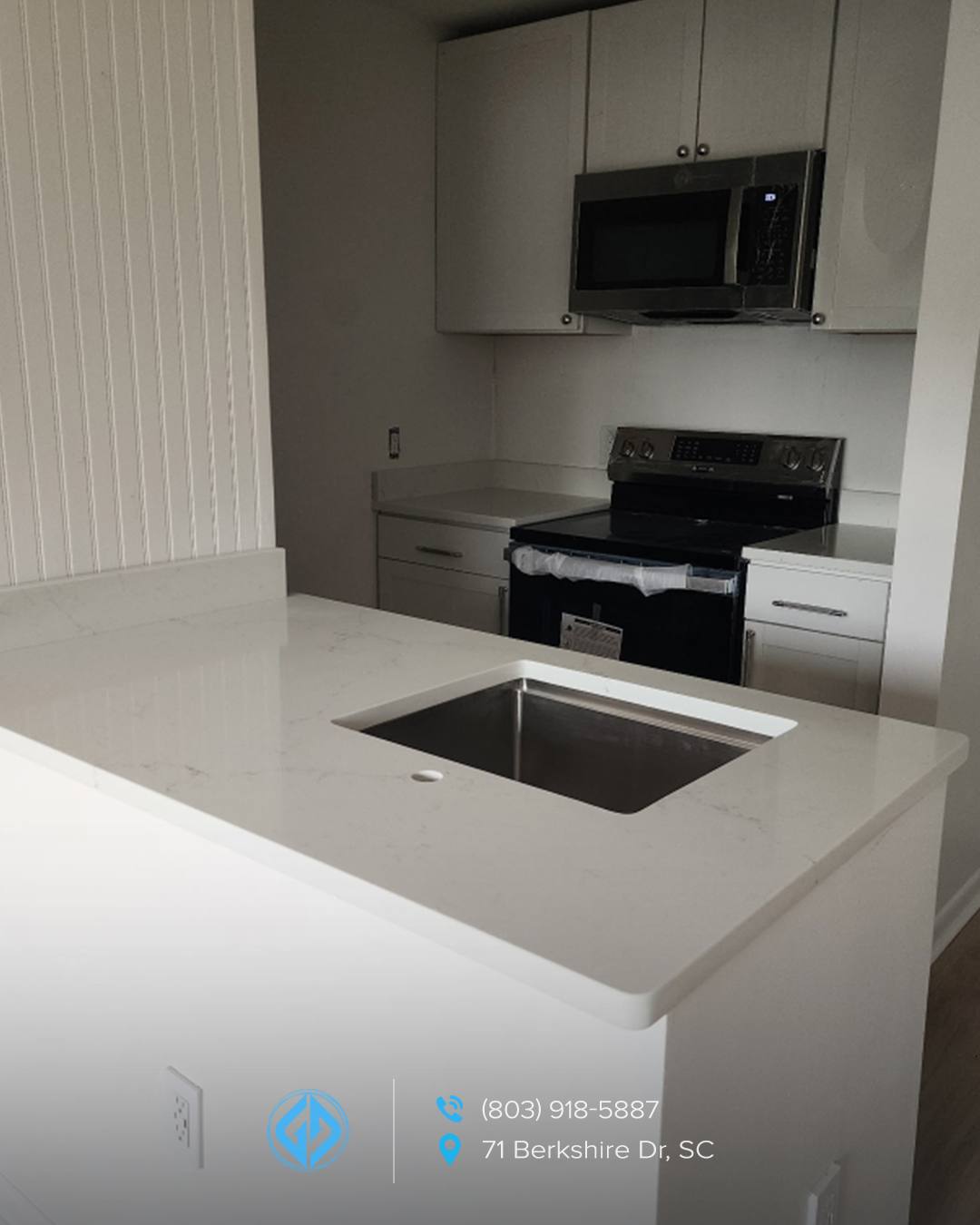
In a small kitchen, the countertop does more visual work than in any other kitchen type. There’s less room for the eye to travel, less visual breathing space around each element, and fewer opportunities to correct a selection that makes the space feel tighter than it actually is. The right quartz countertop choice can make a small kitchen feel significantly more open. The wrong one can make an already compact space feel visually compressed — and the difference often comes down to decisions most homeowners don’t fully consider before selecting.
The good news is that quartz is one of the most controllable materials for this exact purpose. Because it’s engineered with consistent, repeatable patterning, the visual effect of a quartz selection can be predicted accurately before fabrication — something natural stone doesn’t allow to the same degree.
At Granite Depot of Columbia, we install quartz countertops in Manning, SC and throughout the Midlands region regularly, and small kitchen projects require a different selection conversation than large ones. Here’s what actually matters.

What makes a countertop choice visually expand or compress a small kitchen?
The visual perception of space in a small kitchen is driven by contrast, pattern scale, and how the countertop interacts with the surrounding surfaces. These three variables are more controllable in quartz than in any other countertop material, which is one reason quartz is particularly well suited to small kitchen applications.
Contrast is the most powerful variable. High contrast between the countertop and the cabinetry draws the eye to the seam between the two surfaces — which defines and emphasizes the boundaries of the room. In a small kitchen where boundary emphasis makes the space feel more confined, reducing contrast between the countertop and upper cabinetry can visually soften those boundaries and make the room feel more continuous and open.
Pattern scale affects how busy the visual field feels. A quartz with large-scale bold veining in a small kitchen competes for attention with every other surface in the room — there simply isn’t enough visual breathing room for a dramatic pattern to read as intentional rather than overwhelming. A quieter pattern with soft, subtle movement allows the kitchen to feel more ordered and spacious.
Reflectivity affects perceived brightness, which affects perceived size. A polished quartz surface reflects light back into the room, which can make a small kitchen feel brighter and larger. A matte or honed finish absorbs more light, which can make the same space feel slightly darker and more enclosed — worth knowing for kitchens with limited natural light.
Which quartz colors work best in small kitchens?
Light and neutral colors are consistently the strongest choices for small kitchens — not because dark colors are wrong, but because they handle light differently in ways that affect perceived space.
Bright white and soft white quartz are the most reliable choices for small kitchen space expansion. A white quartz countertop against white or light gray cabinets creates a near-continuous light surface that minimizes visual boundary definition and maximizes perceived brightness. Popular options like Silestone’s White Storm, Caesarstone’s Empira White, and MSI’s Calacatta Laza all deliver this effect with varying degrees of veining — from virtually none to softly veined — allowing for different levels of visual interest within the same light palette.
Warm cream and soft beige quartz — Cambria’s Calacatta Nuvo, Silestone’s Silken Pearl — work particularly well in small kitchens with wood-tone or off-white cabinetry. The warmth adds depth without the visual weight of a darker selection, and the connection to natural wood tones creates a cohesive palette that reads as larger than a high-contrast combination would.
Light gray quartz — Caesarstone’s Cloudburst Concrete, Cambria’s Ironsbridge — is a strong choice for contemporary small kitchens. Light gray has enough visual interest to feel designed while remaining light enough to open rather than close the space.
Dark quartz in a small kitchen isn’t impossible, but it requires careful management. A dark island in a small kitchen with light perimeter counters and light cabinetry can work as a deliberate focal point — the contrast is controlled and intentional rather than applied to the whole room. Dark quartz across all surfaces in a small kitchen, however, tends to make the space feel significantly more enclosed.
For quartz countertops in Manning, SC homeowners with smaller kitchen footprints, light neutrals across the full counter run — including the island if there is one — is the selection approach that most consistently produces a more open feeling result.

Does pattern or veining affect perceived space in a small kitchen?
Significantly — and this is where quartz’s engineered consistency gives it a specific advantage for small kitchen applications.
Minimal or no veining — solid or very subtly textured quartz — creates the most visual continuity across the counter surface. The eye travels across the countertop without interruption, which extends the perceived length of the counter run and makes the kitchen feel more spacious. This approach works best with light colors where the absence of pattern reads as clean and intentional rather than stark.
Soft, linear veining — gentle directional movement that runs parallel to the counter’s length — can actually enhance the perception of space by drawing the eye along the counter run rather than across it. A horizontally-oriented soft vein pattern in a light quartz makes a counter run feel longer. Cambria’s Brittanicca Warm and Silestone’s Eternal Calacatta Gold both have this quality when oriented correctly during fabrication.
Bold, large-scale veining in a small kitchen creates visual complexity that competes with the room’s limited space. The pattern needs somewhere to go visually — in a large kitchen it can spread across 50 or 60 feet of surface and read as architectural. In a small kitchen it reads as busy, and busy reads as small.
Random speckled or heavily figured patterns — certain granite-look quartz patterns — create visual noise that can make a small kitchen feel more active and less spacious. These patterns work better in larger kitchens where the surface area gives the pattern room to resolve.
Quartz starts at $50 per square foot at Granite Depot of Columbia in 2026 — and the ability to preview exactly how the pattern will distribute before committing is one of the most practical advantages of engineered stone in a context where getting the pattern scale right matters.
For anyone finalizing plans for quartz countertops in Manning, SC, Granite Depot of Columbia serves Manning and Clarendon County from our Columbia, SC location. We carry quartz starting at $50 per square foot in 2026 from Cambria, Silestone, Caesarstone, and MSI Quartz — and our team walks through color, pattern, and backsplash coordination specifically for small kitchen applications. Most projects are completed within two to three weeks from template to installed countertops. Reach us at (803) 956-4555 or visit us at 71 Berkshire Dr, Columbia, SC 29223.
Frequently Asked Questions
What quartz color makes a small kitchen look bigger?
Light and neutral colors — bright white, soft white, warm cream, and light gray — consistently make small kitchens feel more open. They maximize reflectivity, minimize contrast between surfaces, and reduce the visual boundary definition that makes small kitchens feel more enclosed. At Granite Depot of Columbia, popular small kitchen selections include Silestone White Storm, Caesarstone Empira White, and Cambria Calacatta Nuvo.
How much do quartz countertops cost in Manning, SC in 2026?
At Granite Depot of Columbia, quartz countertops in Manning, SC start at $50 per square foot in 2026. In the Columbia, SC area, quartz typically runs $55 to $100 per square foot installed for mid-range selections. For a standard small kitchen of 25 to 40 square feet, most projects fall between $1,500 and $4,000 fully installed depending on brand, edge profile, and layout complexity.
Should you avoid patterned quartz in a small kitchen?
Not entirely — but pattern scale matters significantly. Soft, linear veining oriented along the counter’s length can actually enhance perceived space. Bold, large-scale veining or heavily figured patterns create visual complexity that competes with limited space and makes small kitchens feel more enclosed. Minimal or softly veined quartz in light colors is the most reliable choice for opening a compact kitchen.
How long does quartz countertop installation take at Granite Depot of Columbia?
Most projects are completed within two to three weeks from first contact to installed countertops. Fabrication runs seven to ten business days after the template appointment, and installation is completed in one to two days for most standard kitchens.
Does Granite Depot of Columbia serve Manning, SC?
Yes. We operate from one location — 71 Berkshire Dr, Columbia, SC 29223 — and serve homeowners looking for quartz countertops in Manning, SC and throughout Clarendon County regularly. We have no separate office in Manning, but our team completes projects there consistently. Call us at (803) 956-4555 to schedule a visit or get a quote.