

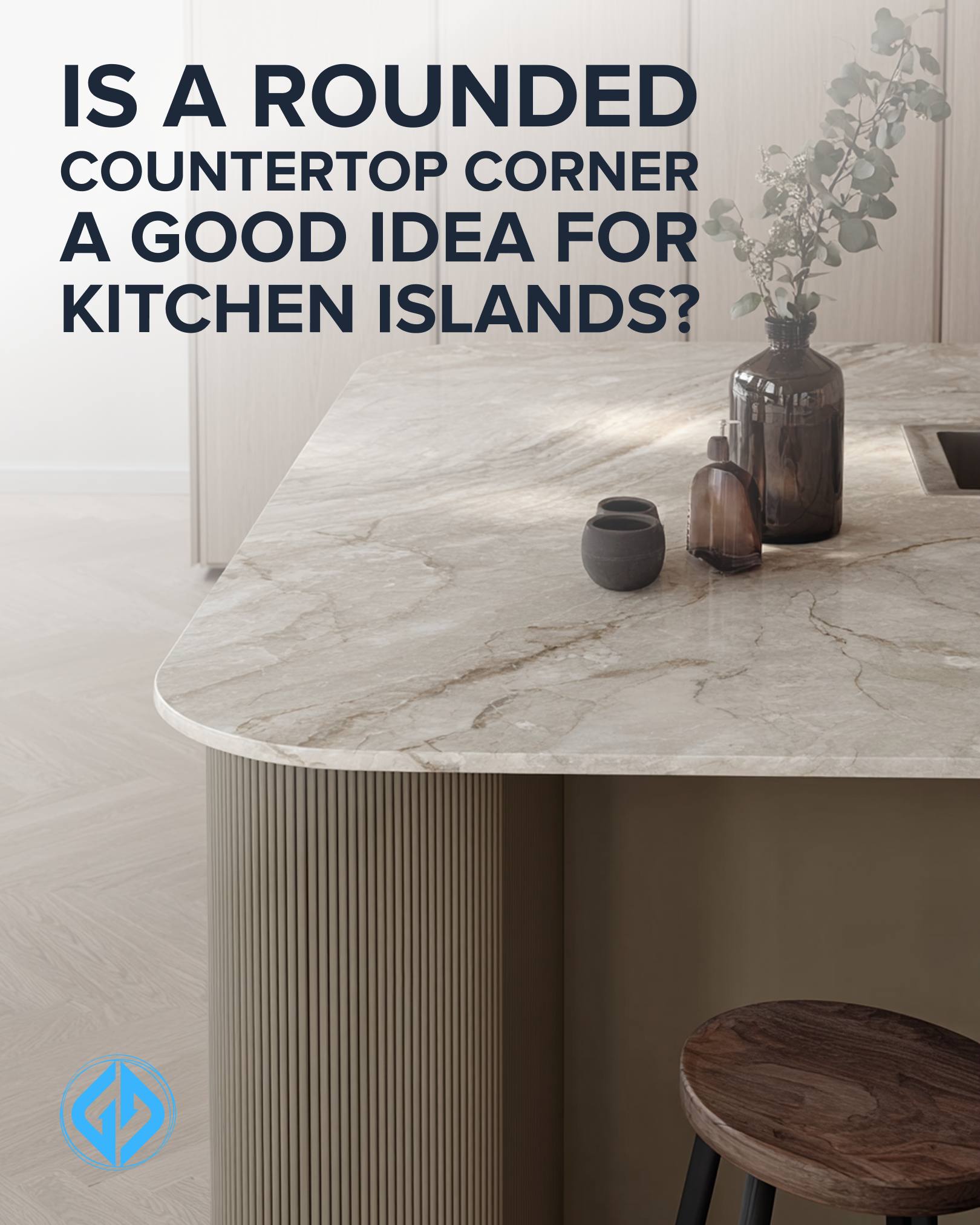
The honest answer is that neither sharp nor rounded island corners are universally better — each serves a different kitchen, a different design language, and a different set of practical priorities. What determines the right choice is a combination of who uses the kitchen, how the island sits within the floor plan, what material the countertop is made from, and what design aesthetic the kitchen is meant to communicate.
That said, rounded corners on kitchen islands are consistently underused and underconsidered — and many homeowners who default to sharp corners without thinking through the question end up wishing they’d chosen differently once the kitchen is in daily use.
At Granite Depot of Columbia, we fabricate and install kitchen countertops in Manning, SC and throughout the Midlands region, and the corner radius question comes up regularly on island projects. Here’s the complete picture.
What are the actual differences between sharp and rounded island corners?
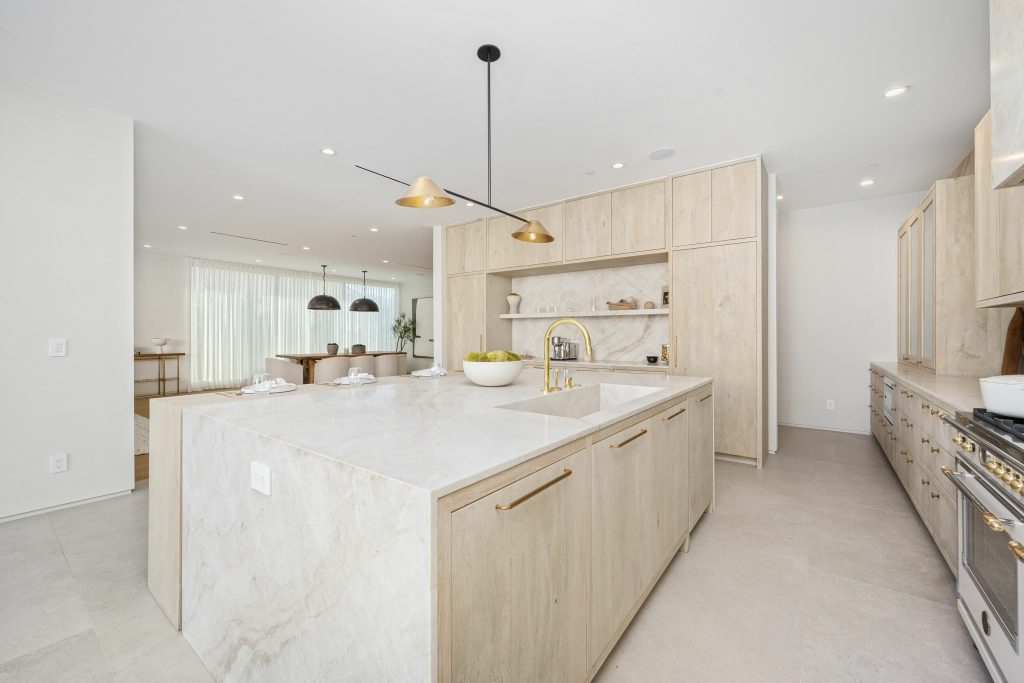
A sharp corner — technically called a square or mitered corner — meets at a 90-degree angle with a clean, defined edge. It reads as precise, architectural, and modern. In photographs, sharp corners make islands look crisp and intentional. In a kitchen with flat-panel cabinetry, integrated appliances, and minimal hardware, a sharp corner island is visually consistent with the design language of everything around it.
A rounded corner introduces a radius — a curve that softens the 90-degree angle into a gentle arc. The radius can range from a subtle 1-inch curve that simply removes the sharpest point, to a generous 3 to 4-inch radius that reads as a deliberate design choice, to a fully radiused end that creates a semicircular island terminus. Each degree of rounding communicates something different aesthetically — subtle rounding reads as a practical refinement, pronounced rounding reads as a design statement.
The fabrication process for rounded corners is the same as for sharp corners on CNC equipment — a programmed radius is simply a different tool path, not a more difficult one. For kitchen countertops in Manning, SC homeowners, this means rounded corners don’t carry a significant fabrication premium over square corners in most standard applications.
When do rounded corners make the most practical sense?
The practical case for rounded corners is strongest in specific kitchen and household contexts where the combination of traffic patterns and corner position creates real daily friction — or real safety risk.
High-traffic kitchen layouts where the island sits in a natural walking path are the strongest case for rounded corners. An island positioned between the refrigerator and the stove, or between the sink and the dining area, sees constant traffic from multiple directions. A sharp corner in that position is hit by hips, hands, and sides of bodies multiple times daily. The accumulated minor impacts aren’t dangerous for adults — but they’re genuinely uncomfortable, and over years of daily kitchen use they become a low-grade irritant that homeowners notice without always identifying as the source of the friction.
Kitchens with young children represent the most cited reason for rounded corners — and it’s a legitimate one. A sharp stone corner at hip height for an adult is at head height for a toddler, and the combination of hard stone and a running child is a real safety consideration. A radius corner doesn’t eliminate the hazard entirely, but it meaningfully reduces the severity of potential impact.
Islands with seating overhangs on one or more ends create a specific corner situation worth thinking through. A sharp corner at the end of a seating overhang is at seated elbow height for the person at the outermost stool — an awkward and occasionally painful position during a meal. A gentle radius at seating-end corners removes this specific daily discomfort without affecting the island’s overall aesthetic in any significant way.
Galley-adjacent layouts where the island is close to a wall or cabinet run on one side amplify the sharp corner problem because traffic is channeled closer to the island edge. In these layouts, the corner gets hit more frequently than in an open island with space on all sides.

When do sharp corners make the most sense?
Sharp corners are the right choice when the design aesthetic is explicitly modern or minimal and visual precision is a primary goal — and when the practical conditions that make rounded corners valuable aren’t present.
A truly minimal kitchen with slab cabinetry, integrated hardware, and a statement stone countertop is a context where sharp corners reinforce the design intention. The clean geometry of a square-cornered island reads as consistent with the kitchen’s visual language in a way that rounded corners would slightly undercut. In this context, choosing rounded corners purely for safety reasons in a household without young children or high-traffic collision patterns is a design compromise that isn’t required.
Islands positioned in open kitchen layouts with generous circulation space on all sides also reduce the practical argument for rounded corners — if the corner is rarely walked into because there’s adequate space around the island, the safety and comfort benefit is minimal.
The materials that most strongly support sharp corners aesthetically are dark, uniform granites — Absolute Black, Steel Grey — and strongly veined marbles and quartzites where the geometric precision of a sharp corner edge reads as deliberately architectural. On these materials, the edge itself becomes a design element, and softening it loses part of the visual effect.
Does material affect the rounded vs. sharp corner decision?
Yes — both structurally and aesthetically.
Granite handles sharp corners well structurally. At Mohs 6 to 7, the stone is dense enough that a square corner edge isn’t particularly vulnerable to chipping under normal kitchen contact. Sharp granite corners can withstand daily use without degrading noticeably. Rounded corners on granite are purely a functional and aesthetic choice rather than a structural one.
Marble at Mohs 3 to 4 is more vulnerable at sharp corner edges than granite. The softness that makes marble beautiful also makes it more susceptible to chipping at thin, exposed corner points with repeated impact. A gentle radius corner on a marble island isn’t just a functional choice — it’s a mild structural protection against the kind of edge chipping that’s more likely on marble than on harder stones. Marble starts at $65 per square foot at Granite Depot of Columbia in 2026.
Quartz is structurally similar to granite at the corner, but its resin content means corner impact can cause a different type of damage — a chipped corner on quartz sometimes reveals the resin binder differently than a chipped granite corner. For quartz islands, particularly at seating-end corners that see frequent contact from chairs and stools, a modest radius is worth considering as mild structural insurance. Quartz starts at $50 per square foot at Granite Depot of Columbia in 2026.
Quartzite at Mohs 7 and above is the most corner-durable natural stone — its hardness makes sharp corners highly resistant to chipping even with regular contact. Sharp corners on quartzite are structurally sound for any kitchen layout.
| Material | Sharp Corner Durability | Rounded Corner Benefit |
|---|---|---|
| Granite | Very good | Primarily functional/aesthetic |
| Quartz | Good | Mild structural + functional |
| Marble | Moderate — chip risk | Structural + functional |
| Quartzite | Excellent | Primarily functional/aesthetic |
What radius sizes are available and how do they read visually?
Radius sizing is measured as the radius of the curve — a 1-inch radius removes only the sharpest point and is barely noticeable, while a 4-inch radius creates a visibly rounded corner that reads as a design choice. Standard options in 2026 typically run from 1 inch through 4 inches, with some fabricators offering fully radiused semicircular ends for specific island designs.
A 1-inch radius is the practical minimum — it removes the sharpest corner point, provides the safety and comfort benefit of a rounded edge, and is virtually invisible as a design choice. From most viewing angles it looks like a square corner. This is the right choice for homeowners who want the functional benefit without any visual departure from the sharp-corner aesthetic.
A 2 to 3-inch radius is the most common design choice for rounded corners — visible as a deliberate softening but not dramatic enough to dominate the island’s aesthetic. It reads as considered and intentional. In a transitional kitchen, this radius level feels natural and appropriate without requiring the full design commitment of a more pronounced curve.
A 4-inch or larger radius makes a clear aesthetic statement — the island reads as having a distinctly rounded end that’s a design feature rather than a safety refinement. This works well in transitional and traditional kitchens but can feel slightly incongruent in a strictly modern or minimal design.
For anyone finalizing kitchen countertops in Manning, SC, Granite Depot of Columbia serves Manning and Clarendon County from our Columbia, SC location. We carry granite starting at $39 per square foot, quartz at $50, and marble at $65 in 2026 — and corner radius selection is part of every island project consultation before fabrication begins. Most projects are completed within two to three weeks from template to installed countertops. Reach us at (803) 956-4555 or visit us at 71 Berkshire Dr, Columbia, SC 29223.