


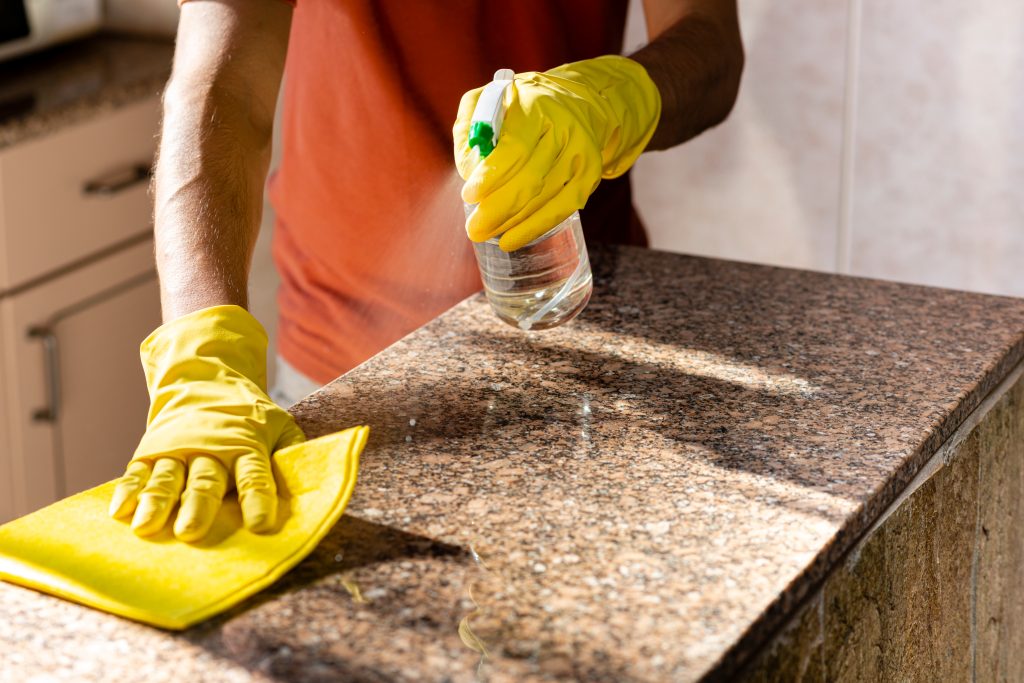
The safest and most effective way to disinfect any stone countertop — granite, quartz, marble, or quartzite — is isopropyl alcohol at 70% concentration. It kills the same bacteria and viruses as bleach-based products, evaporates cleanly without leaving residue, and doesn’t damage stone surfaces or sealers the way most household disinfectants do. Apply with a soft cloth, let it sit for thirty seconds, wipe clean.
That’s the short answer. The longer answer matters because the products most homeowners reach for when they want to disinfect — Clorox spray, Lysol, bleach solution, vinegar — range from mildly problematic to genuinely damaging on stone surfaces. Understanding which products are safe and which aren’t is what keeps a countertop looking like new rather than degrading gradually over years of well-intentioned cleaning.
At Granite Depot of Columbia, we install kitchen countertops in Cheraw, SC and throughout the Midlands region in all four materials, and cleaning product questions are among the most consistent follow-ups we get after installation. Here’s the complete picture.
Why do standard household disinfectants damage stone?
Most household disinfectant products are formulated for non-porous surfaces like glass, plastic, and ceramic tile. Stone countertops — including engineered quartz — have specific vulnerabilities that those formulations don’t account for.
Bleach and bleach-based sprays are the most commonly used damaging product on stone countertops. On natural stone — granite, marble, quartzite — bleach degrades the penetrating sealer that protects against staining, leaving the stone increasingly vulnerable with each application. On quartz, bleach attacks the polymer resins that bind the quartz crystals, causing gradual surface discoloration and dulling that accumulates invisibly until the damage is significant.
Acidic disinfectants — products containing citric acid, acetic acid, or vinegar — are the second major category of concern. On marble specifically, acidic products cause etching — the chemical dissolution of calcite at the stone surface — regardless of whether the marble is sealed. On granite and quartzite, repeated acidic contact degrades the sealer and eventually affects the stone surface beneath it.
Quaternary ammonium compounds — the active ingredient in many Lysol and similar products — are less immediately damaging than bleach but still not recommended for regular use on stone. They leave a film residue that builds up over time and dulls the surface finish, particularly on polished stone.
For kitchen countertops in Cheraw, SC and any stone surface, the core principle is the same: effective disinfection doesn’t require harsh chemistry. It requires the right chemistry for the material.
What disinfectants are safe for each stone type?
The safe disinfectant list is shorter than most homeowners expect — but it covers every realistic disinfection need a kitchen produces.
Isopropyl alcohol at 70% is the universal safe choice across all four stone materials. It’s effective against bacteria, viruses, and fungi, evaporates without residue, and doesn’t affect sealers, resins, or stone surfaces at this concentration. Higher concentrations — 90% and above — evaporate too quickly to be effective disinfectants. Standard 70% drugstore isopropyl alcohol is the right product.
Hydrogen peroxide at 3% — standard drugstore concentration — is safe on granite, quartz, and quartzite and effective against most household pathogens. On marble, brief contact at this concentration is generally safe, but prolonged contact should be avoided as higher concentrations can affect the calcite surface.
pH-neutral stone-safe disinfectant sprays — products specifically formulated for natural stone and engineered quartz, such as Granite Gold Daily Cleaner or Black Diamond Stone Cleaner — are safe across all materials and effective for routine surface sanitation. These are the products worth keeping under the counter for daily use.
Mild dish soap and hot water is technically not a disinfectant but is effective at removing the majority of surface bacteria through mechanical action — the surfactant in dish soap disrupts bacterial cell walls when combined with friction from wiping. For everyday kitchen cleanup, this combination handles most sanitation needs without any chemical risk to the stone.
| Product | Granite | Quartz | Marble | Quartzite |
|---|---|---|---|---|
| Isopropyl alcohol 70% | ✅ Safe | ✅ Safe | ✅ Safe | ✅ Safe |
| Hydrogen peroxide 3% | ✅ Safe | ✅ Safe | ⚠️ Brief contact only | ✅ Safe |
| pH-neutral stone cleaner | ✅ Safe | ✅ Safe | ✅ Safe | ✅ Safe |
| Bleach / Clorox spray | ❌ Damages sealer | ❌ Damages resin | ❌ Damages sealer + etches | ❌ Damages sealer |
| Vinegar-based products | ❌ Degrades sealer | ❌ Degrades resin | ❌ Etches surface | ❌ Degrades sealer |
| Lysol / Quat-based sprays | ⚠️ Occasional only | ⚠️ Occasional only | ❌ Not recommended | ⚠️ Occasional only |
Does disinfection work differently on sealed vs. unsealed stone?
Yes — and this distinction matters practically for granite, marble, and quartzite, all of which require periodic sealing.
A properly sealed natural stone surface has a penetrating sealer that fills the stone’s pores and creates a protective barrier against liquid absorption. Safe disinfectants — isopropyl alcohol, hydrogen peroxide, pH-neutral sprays — work effectively on sealed stone without affecting sealer integrity when used as directed.
Bleach and acidic products degrade this sealer over time even when the stone surface itself appears unaffected. The damage is cumulative — each application removes a small amount of sealer protection, and over months the stone becomes increasingly porous and vulnerable to staining. This is why homeowners who clean granite regularly with vinegar-based sprays or Clorox sometimes find staining issues appearing a year or two after installation despite having “cleaned” the surface consistently.
At Granite Depot of Columbia, we apply a professional-grade penetrating sealer on every natural stone installation as standard. Granite starts at $39 per square foot in 2026, marble at $65, and quartz at $50 — quartz being the only material in this group that requires no sealing and is therefore less vulnerable to sealer degradation from inappropriate cleaning products.
How should disinfection fit into a regular stone cleaning routine?
Daily cleaning and disinfection are different tasks with different products, and keeping them separate produces the best long-term results.
Daily cleaning — warm water, mild dish soap, soft cloth — handles food residue, grease, and surface contact from cooking. This is the routine that should happen after every use in an active kitchen. No disinfectant is required for daily cleanup under normal household conditions.
Targeted disinfection — isopropyl alcohol 70% or pH-neutral stone disinfectant — is appropriate after handling raw meat or poultry, during illness in the household, or any time surface sanitation genuinely matters beyond standard cleaning. Apply, let sit thirty seconds minimum, wipe clean with a damp cloth.
Deep cleaning — monthly or as needed — can include a pH-neutral stone cleaner applied more thoroughly to address buildup in high-contact areas around the sink and stove.
What should never happen is using bleach, Clorox, vinegar, or Lysol as a substitute for any of these steps. The products that feel like the strongest disinfectants are often the ones doing the most cumulative damage to stone surfaces over time.
For anyone finalizing plans for kitchen countertops in Cheraw, SC, Granite Depot of Columbia serves Cheraw and Chesterfield County from our Columbia, SC location. We carry granite, quartz, marble, and quartzite and provide cleaning and maintenance guidance for every material we install. Most projects are completed within two to three weeks from template to installed countertops. Reach us at (803) 956-4555 or visit us at 71 Berkshire Dr, Columbia, SC 29223.
Frequently Asked Questions
What is the safest way to disinfect stone countertops?
Isopropyl alcohol at 70% concentration is the safest and most effective disinfectant for granite, quartz, marble, and quartzite. Apply with a soft cloth, let sit thirty seconds, wipe clean. It kills bacteria and viruses without damaging sealers, resins, or stone surfaces — unlike bleach, vinegar, and most household disinfectant sprays.
Can you use Clorox or bleach on granite or quartz countertops?
No. Bleach degrades the penetrating sealer on natural stone, leaving it increasingly vulnerable to staining over time. On quartz, bleach attacks the polymer resins and causes gradual surface discoloration. Occasional accidental contact is unlikely to cause visible damage, but regular use produces cumulative harm that becomes apparent over months of consistent application.
How much do kitchen countertops cost in Cheraw, SC in 2026?
At Granite Depot of Columbia, granite starts at $39 per square foot, quartz at $50, and marble at $65 in 2026. In the Columbia, SC area, installed countertop costs generally range from $50 to $150 per square foot. For a standard kitchen of 40 to 50 square feet, most projects fall between $2,000 and $6,000 fully installed depending on material and complexity.
How long does countertop installation take at Granite Depot of Columbia?
Most projects are completed within two to three weeks from first contact to installed countertops. Fabrication runs seven to ten business days after the template appointment, and installation is completed in one to two days for most standard kitchens.
Does Granite Depot of Columbia serve Cheraw, SC?
Yes. We operate from one location — 71 Berkshire Dr, Columbia, SC 29223 — and serve homeowners looking for kitchen countertops in Cheraw, SC and throughout Chesterfield County regularly. We have no separate office in Cheraw, but our team completes projects there consistently. Call us at (803) 956-4555 to schedule a visit or get a quote.